


C-AIG-2412 Dumps PDF - C-AIG-2412 Real Exam Questions Answers
Get Started: C-AIG-2412 Exam [2025] Dumps SAP PDF Questions
NEW QUESTION # 38
What is the primary function of the embedding model in a RAG system?
- A. To generate responses based on retrieved documents and user queries
- B. To evaluate the faithfulness and relevance of generated Answers
- C. To encode queries and documents into vector representations for comparison
- D. To store vector representations of documents and search for relevant passages
Answer: C
Explanation:
In a Retrieval-Augmented Generation (RAG) system, the embedding model plays a crucial role in encoding textual data into vector representations, facilitating efficient retrieval and comparison.
1. Function of the Embedding Model:
* Vector Encoding:The embedding model transforms both user queries and documents into high- dimensional vector representations. This numerical encoding captures the semantic meaning of the text, enabling the system to assess similarities between different pieces of text effectively.
* Facilitating Retrieval:By encoding text into vectors, the system can perform efficient similarity searches within a vector database, identifying documents or passages that are most relevant to the user's query.
2. Importance in RAG Systems:
* Semantic Matching:The vector representations allow the system to match user queries with relevant documents based on semantic content rather than mere keyword overlap, enhancing the relevance of retrieved information.
* Efficiency:Vector-based retrieval is computationally efficient, enabling rapid identificationof pertinent information from large datasets, which is essential for real-time applications.
3. Application in SAP's Generative AI Hub:
* Integration with HANA Vector Search:SAP's Generative AI Hub integrates embedding models with HANA's vector search capabilities, allowing for efficient storage and retrieval of vector embeddings.
This integration supports the development of RAG systems that can effectively utilize SAP's data assets.
* Generative AI Hub SDK:SAP provides an SDK that facilitates the implementation of embedding models within RAG systems, enabling developers to encode queries and documents into vector representations seamlessly.
NEW QUESTION # 39
What capabilities does the Exploration and Development feature of the generative Al hub provide?
Note: There are 2 correct answers to this question.
- A. Al playground and chat
- B. Develop and debug ABAP code
- C. Prompt editor and management
- D. Automatic model selection
Answer: A,C
NEW QUESTION # 40
You want to use the orchestration service through SAP's generative-Al-hub-sdk. What does the following code do?
from gen_ai_hub.orchestration.models.11m import LLM 11m =
LLM(name="gpt-40", version="latest", parameters={"max_tokens": 256, "temperature": 0.2})
- A. Run the Orchestration Request
- B. Define the Template and Default Input Values
- C. Define the LLM
- D. Create the Orchestration Configuration
Answer: C
Explanation:
The provided code snippet defines a Large Language Model (LLM) within the SAP Generative AI Hub SDK's orchestration service:
from gen_ai_hub.orchestration.models.llm import LLM
llm = LLM(name="gpt-40", version="latest", parameters={"max_tokens": 256, "temperature": 0.2})
1. Importing the LLM Class:
* Code:from gen_ai_hub.orchestration.models.llm import LLM
* Purpose:Imports the LLM class from the SDK, enabling the creation of an LLM instance.
2. Defining the LLM Instance:
* Code:llm = LLM(name="gpt-40", version="latest", parameters={"max_tokens": 256, "temperature":
0.2})
* Parameters:
* name:Specifies the model's name, in this case, "gpt-40".
* version:Indicates the model version, set to "latest" to use the most recent version.
* parameters:A dictionary defining model-specific parameters:
* max_tokens:Sets the maximum number of tokens (words or word pieces) the model can generate, here limited to 256 tokens.
* temperature:Controls the randomness of the output; a lower value like 0.2 results in more deterministic responses.
3. Role in Orchestration Pipeline:
* Function:This definition is a crucial step in the orchestration pipeline, specifying which LLM to use and configuring its behavior for subsequent tasks.
Conclusion:
The code snippet defines an LLM named "gpt-40" with specific parameters, preparing it for integration into an AI-driven workflow within SAP's Generative AI Hub.
NEW QUESTION # 41
Which of the following are functionalities provided by the generative-Al-hub-SDK ?
Note: There are 2 correct answers to this question.
- A. Create chat responses and embeddings
- B. Interact with LLMs
- C. Customize SAP AI Launchpad
- D. Configure SAP BTP credentials
Answer: A,B
NEW QUESTION # 42
Which of the following describes Large Language Models (LLMs)?
- A. They utilize deep learning to process and generate human-like text
- B. They generate responses based on pre-defined templates without learning from data
- C. They can only process numerical data and are not capable of understanding text
- D. They rely on traditional rule-based algorithms to generate responses
Answer: A
Explanation:
Large Language Models (LLMs) are advanced AI systems that leverage deep learning techniques, specifically transformer architectures with self-attention mechanisms, to process and generate human-like text. Option A is incorrect because LLMs do not rely on traditional rule-based systems; they learn patterns from vast datasets. Option C is false as LLMs are designed for text processing, not limited to numerical data. Option D is also inaccurate since LLMs generate responses based on learned patterns, not static templates. Option B is correct, reflecting how LLMs, like those accessible via SAP's Generative AI Hub, use deep learning to understand context, semantics, and generate coherent text for applications such as chatbots, translations, and content creation.
NEW QUESTION # 43
What are the applications of generative Al that go beyond traditional chatbot applications?
Note: There are 2 correct answers to this question.
- A. To produce outputs based on software input.
- B. To interpret human instructions and control software systems always producing output for human consumption.
- C. To interpret human instructions and control software systems without necessarily producing output for human consumption.
- D. To follow a specific schema - human input, Al processing, and output for human consumption.
Answer: B,C
NEW QUESTION # 44
Which of the following executables in generative Al hub works with Anthropic models?
- A. GCP Vertex Al
- B. Azure OpenAl Service
- C. AWS Bedrock
- D. SAP AI Core
Answer: C
NEW QUESTION # 45
What are some features of Joule?
Note: There are 3 correct answers to this question.
- A. Providing coding assistance and content generation.
- B. Generating standalone applications.
- C. Streamlining tasks with an Al assistant that knows your unique role.
- D. Downloading and processing data.
- E. Maintaining data privacy while offering generative Al capabilities.
Answer: A,C,E
Explanation:
B: Providing coding assistance and content generation:
* Coding:Joule can help developers write code faster and with fewer errors. Imagine you need to create a simple report in ABAP (SAP's programming language). Instead of remembering the exact syntax and functions, you could describe what you need to Joule in plain English. It could then generate the code snippet, saving you time and reducing the chance of mistakes. This applies to other coding languages too, not just those within the SAP ecosystem.
* Content generation:Joule can create different kinds of content, such as:
* Emails:Need to send a quick update to your team? Tell Joule what information to include, and it can draft the email for you.
* Reports:Joule can analyze data and generate summaries or reports based on your requirements.
* Presentations:Need to create a slide deck? Joule can help you structure it and even suggest relevant content.
* Translations:Joule can translate text between multiple languages, making it easier to collaborate with colleagues around the world.
C: Maintaining data privacy while offering generative AI capabilities:
* Data security is paramount:SAP understands that businesses deal with sensitive data. Joule is built with strong security measures to protect this information. This includes things like encryption and access controls to ensure that only authorized users can see sensitive data.
* Privacy-preserving AI:Joule uses techniques like differential privacy to ensure that AI models don't inadvertently reveal private information while still providing valuable insights. This means that even if Joule learns from your company's data, it won't be possible to reconstruct that data or identify individuals from the AI's output.
D: Streamlining tasks with an AI assistant that knows your unique role:
* Personalized experience:Joule learns about your job title, department, and the tasks you typically perform. This allows it to provide more relevant and helpful suggestions.
* Contextual awareness:Joule understands the context of your work. For example, if you're a financial analyst, Joule will prioritize providing assistance related to finance tasks and data.
* Proactive help:Joule doesn't just wait for you to ask questions. It can anticipate your needs and proactively offer help. For instance, if you're working on a sales forecast, Joule might suggest relevant data sources or provide insights from previous forecasts.
In essence, Joule aims to be a powerful AI assistant that makes your work life easier and more efficient while keeping your data safe and respecting your privacy.
NEW QUESTION # 46
Match the components of a Retrieval Augmented Generation architecture to the diagram.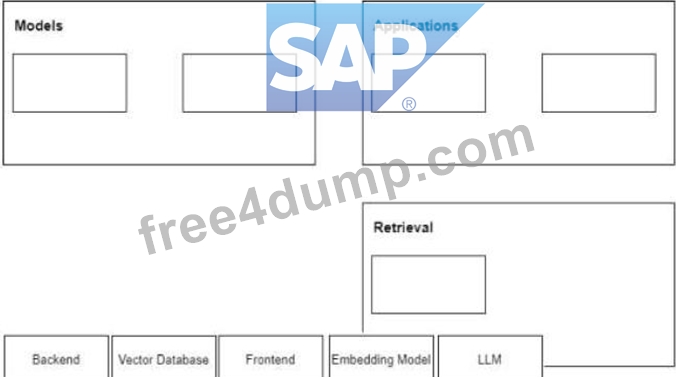
Answer:
Explanation: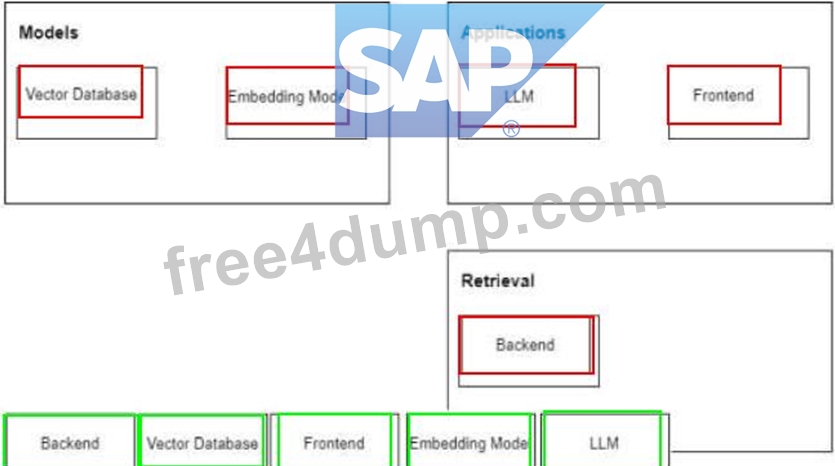
NEW QUESTION # 47
Which of the following is unique about SAP's approach to Al?
- A. Offering Al capabilities in their future products as of 2025.
- B. SAP's deep integration of Al with business processes and analytics.
- C. Focusing Al solely on customer support services.
- D. Utilizing Al mainly for marketing purposes.
Answer: B
NEW QUESTION # 48
What are some characteristics of the SAP generative Al hub? Note: There are 2 correct answers to this question.
- A. It ensures relevant, reliable, and responsible business Al.
- B. It provides instant access to a wide range of large language models (LLMs).
- C. It operates independently of SAP's partners and ecosystem.
- D. It only supports traditional machine learning models.
Answer: A,B
NEW QUESTION # 49
What are some functionalities provided by SAP Al Core?
Note: There are 3 correct answers to this question.
- A. Continuous delivery and tenant isolation for scalability
- B. Orchestration of Al workflows such as model training and inference
- C. Monitoring and retraining models in SAP Al Core
- D. Management of SAP S/4HANA cloud infrastructure
- E. Integration of Al services with business applications using a standardized API
Answer: A,B,E
NEW QUESTION # 50
What can be done once the training of a machine learning model has been completed in SAP AI Core? Note: There are 2 correct answers to this question.
- A. The model can be registered in the hyperscaler object store.
- B. The model can be deployed for inferencing.
- C. The model's accuracy can be optimized directly in SAP HANA.
- D. The model can be deployed in SAP HANA.
Answer: A,B
NEW QUESTION # 51
Why would a user include formatting instructions within a prompt?
- A. To force the model to separate relevant and irrelevant output
- B. To ensure the model's response follows a desired structure or style
- C. To increase the faithfulness of the output
- D. To redirect the output to another software program
Answer: B
NEW QUESTION # 52
What are some benefits of the SAP AI Launchpad? Note: There are 2 correct answers to this question.
- A. Centralized Al lifecycle management for all Al scenarios.
- B. Direct deployment of Al models to SAP HAN
- C. Integration with non-SAP platforms like Azure and AWS.
- D. Simplified model retraining and performance improvement.
Answer: A,D
NEW QUESTION # 53
Which of the following is a benefit of using Retrieval Augmented Generation?
- A. It reduces the computational resources required for language modeling.
- B. It enables LLMs to learn new languages without additional training.
- C. It allows LLMs to access and utilize information beyond their initial training data.
- D. It eliminates the need for fine-tuning LLMs for specific tasks.
Answer: C
NEW QUESTION # 54
Which of the following steps is NOT a requirement to use the Orchestration service?
- A. Create a deployment for orchestration
- B. Get an auth token for orchestration
- C. Modify the underlying Al models
- D. Create an instance of an Al model
Answer: C
Explanation:
To utilize the Orchestration service in SAP's Generative AI Hub, several steps are required; however, modifying the underlying AI models is not among them:
1. Required Steps:
* Get an Auth Token for Orchestration:Obtain authentication credentials to access the orchestration service.
* Create an Instance of an AI Model:Set up an instance of the desired AI model to be used within the orchestration pipeline.
* Create a Deployment for Orchestration:Deploy the configured AI model instance to the orchestration service, enabling it for processing requests.
2. Not Required:
* Modify the Underlying AI Models:The orchestration service allows users to utilize pre-existing AI models without the need to alter their foundational architecture or training.
NEW QUESTION # 55
What must be defined in an executable to train a machine learning model using SAP AI Core? Note: There are 2 correct answers to this question.
- A. Deployment templates for SAP AI Launchpad
- B. Pipeline containers to be used
- C. User scripts to manually execute pipeline steps
- D. Infrastructure resources such as CPUs or GPUs
Answer: B,D
Explanation:
When training a machine learning model using SAP AI Core, defining an executable requires specifying certain key components to ensure the training process is efficient and effective.
1. Pipeline Containers to Be Used:
* Definition:Pipeline containers encapsulate the environments and dependencies necessary for each step of the machine learning workflow, including data preprocessing, model training, and evaluation.
* Specification in Executable:Within the executable, it's essential to define which pipeline containers will be utilized to ensure that each stage of the training process has the appropriate tools and libraries.
NEW QUESTION # 56
Which of the following steps must be performed to deploy LLMs in the generative Al hub?
- A. Run the booster
* Create service keys
* Select the executable ID - B. Provision SAP AI
* Core Create a configuration
* Run the booster - C. Provision SAP AI Core
* Check for foundation model scenario
* Create a configuration
* Create a deployment - D. Check for foundation model scenario
* Create a deployment
* Configuring entitlements
Answer: C
NEW QUESTION # 57
How do resource groups in SAP AI Core improve the management of machine learning workloads?
Note: There are 2 correct answers to this question.
- A. They enable simultaneous orchestration of Kubernetes clusters.
- B. They enhance pipeline execution speeds through workload distribution.
- C. They ensure workload separation for different tenants or departments.
- D. They provide isolation for datasets and Al artifacts.
Answer: C,D
NEW QUESTION # 58
......
C-AIG-2412 Premium Exam Engine pdf Download: https://passleader.free4dump.com/C-AIG-2412-real-dump.html