


Get 100% Success with Latest Azure Cosmos DB Developer Specialty DP-420 Exam Dumps Nov 10, 2025
The Best DP-420 Exam Study Material and Preparation Test Question Dumps
Microsoft DP-420 exam is designed to test the skills and knowledge of professionals who are looking to specialize in cloud-native application development using Microsoft Azure Cosmos DB. DP-420 exam is suitable for individuals who want to validate their expertise in designing and implementing cloud-native applications using Cosmos DB, which is a globally distributed, multi-model database service offered by Microsoft Azure.
NEW QUESTION # 76
You have a container named container1 in an Azure Cosmos DB Core (SQL) API account.
The following is a sample of a document in container1.
{
"studentId": "631282",
"firstName": "James",
"lastName": "Smith",
"enrollmentYear": 1990,
"isActivelyEnrolled": true,
"address": {
"street": "",
"city": "",
"stateProvince": "",
"postal": "",
}
}
The container1 container has the following indexing policy.
{
"indexingMode": "consistent",
"includePaths": [
{
"path": "/*"
},
{
"path": "/address/city/?"
}
],
"excludePaths": [
{
"path": "/address/*"
},
{
"path": "/firstName/?"
}
]
}
For each of the following statements, select Yes if the statement is true. Otherwise, select No.
NOTE: Each correct selection is worth one point.
Answer:
Explanation:
Explanation
Box 1: Yes
"path": "/*" is in includePaths.
Include the root path to selectively exclude paths that don't need to be indexed. This is the recommended approach as it lets Azure Cosmos DB proactively index any new property that may be added to your model.
Box 2: No
"path": "/firstName/?" is in excludePaths.
Box 3: Yes
"path": "/address/city/?" is in includePaths
Reference: https://docs.microsoft.com/en-us/azure/cosmos-db/index-policy
NEW QUESTION # 77
You have an Azure Cosmos DB Core (SQL) account that has a single write region in West Europe.
database named db
For each of the following statements, select Yes if the statement is true. Otherwise, select No.
NOTE: Each correct selection is worth one point.
Answer:
Explanation:
Explanation:
Box 1: Yes
The Automatic failover option allows Azure Cosmos DB to failover to the region with the highest failover priority with no user action should a region become unavailable.
Box 2: No
West Europe is used for failover. Only North Europe is writable.
To Configure multi-region set UseMultipleWriteLocations to true.
Box 3: Yes
Provisioned throughput with single write region costs $0.008/hour per 100 RU/s and provisioned throughput with multiple writable regions costs $0.016/per hour per 100 RU/s.
Reference:
https://docs.microsoft.com/en-us/azure/cosmos-db/sql/how-to-multi-master
https://docs.microsoft.com/en-us/azure/cosmos-db/optimize-cost-regions
NEW QUESTION # 78
You are creating a database in an Azure Cosmos DB Core (SQL) API account. The database will be used by an application that will provide users with the ability to share online posts. Users will also be able to submit comments on other users' posts.
You need to store the data shown in the following table.
The application has the following characteristics:
Users can submit an unlimited number of posts.
The average number of posts submitted by a user will be more than 1,000.
Posts can have an unlimited number of comments from different users.
The average number of comments per post will be 100, but many posts will exceed 1,000 comments.
Users will be limited to having a maximum of 20 interests.
For each of the following statements, select Yes if the statement is true. Otherwise, select No.
NOTE: Each correct selection is worth one point.
Answer:
Explanation:
NEW QUESTION # 79
You need to implement a solution to meet the product catalog requirements.
What should you do to implement the conflict resolution policy.
- A. Set the default consistency level for account1 to eventual.
- B. Disable indexing on all fields in the index policy of the con-product container.
- C. Create a new container and migrate the product catalog data to the new container.
- D. Remove frequently changed field from the index policy of the con-product container.
Answer: A
NEW QUESTION # 80
You plan to deploy two Azure Cosmos DB Core (SQL) API accounts that will each contain a single database.
The accounts will be configured as shown in the following table.
How should you provision the containers within each account to minimize costs? To answer, select the appropriate options in the answer area.
NOTE: Each correct selection is worth one point.
Answer:
Explanation:
Explanation
Box 1: Serverless capacity mode
Azure Cosmos DB serverless best fits scenarios where you expect intermittent and unpredictable traffic with long idle times. Because provisioning capacity in such situations isn't required and may be cost-prohibitive, Azure Cosmos DB serverless should be considered in the following use-cases:
Getting started with Azure Cosmos DB
Running applications with bursty, intermittent traffic that is hard to forecast, or low (<10%) average-to-peak traffic ratio Developing, testing, prototyping and running in production new applications where the traffic pattern is unknown Integrating with serverless compute services like Azure Functions Box 2: Provisioned throughput capacity mode and autoscale throughput The use cases of autoscale include:
Variable or unpredictable workloads: When your workloads have variable or unpredictable spikes in usage, autoscale helps by automatically scaling up and down based on usage. Examples include retail websites that have different traffic patterns depending on seasonality; IOT workloads that have spikes at various times during the day; line of business applications that see peak usage a few times a month or year, and more. With autoscale, you no longer need to manually provision for peak or average capacity.
Reference:
https://docs.microsoft.com/en-us/azure/cosmos-db/serverless
https://docs.microsoft.com/en-us/azure/cosmos-db/provision-throughput-autoscale#use-cases-of-autoscale
NEW QUESTION # 81
You have the indexing policy shown in the following exhibit.
Use the drop-down menus to select the answer choice that answers each question based on the information presented in the graphic.
NOTE: Each correct selection is worth one point.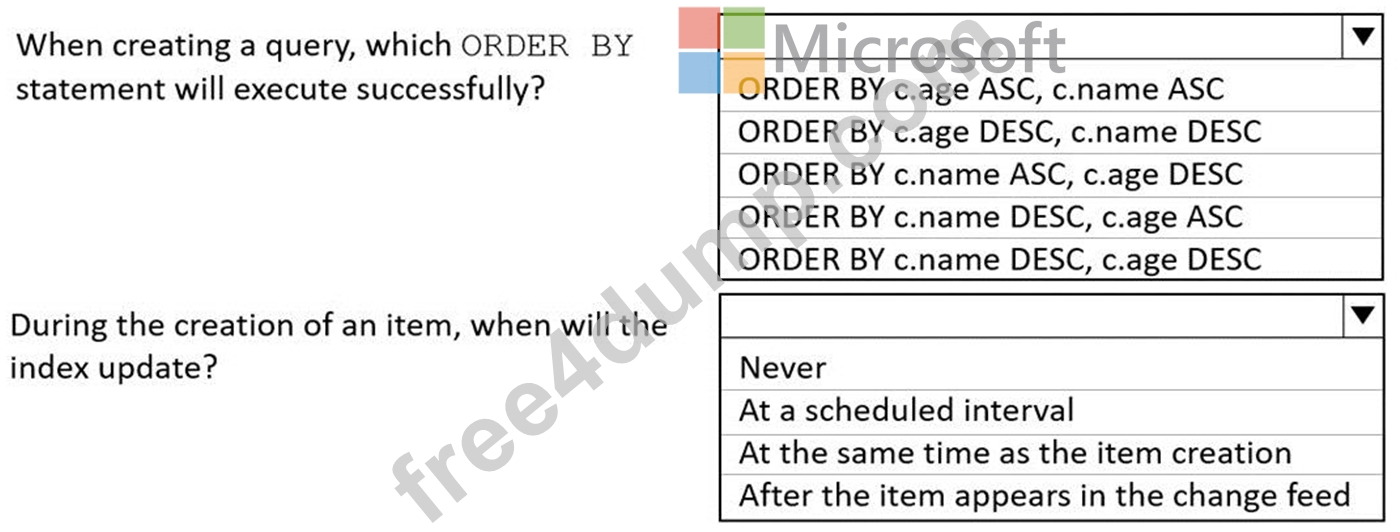
Answer:
Explanation:
NEW QUESTION # 82
Note: This question is part of a series of questions that present the same scenario. Each question in the series contains a unique solution that might meet the stated goals. Some question sets might have more than one correct solution, while others might not have a correct solution.
After you answer a question in this section, you will NOT be able to return to it. As a result, these questions will not appear in the review screen.
You have a container named container1 in an Azure Cosmos DB Core (SQL) API account.
You need to make the contents of container1 available as reference data for an Azure Stream Analytics job.
Solution: You create an Azure function that uses Azure Cosmos DB Core (SQL) API change feed as a trigger and Azure event hub as the output.
Does this meet the goal?
- A. Yes
- B. No
Answer: B
Explanation:
Explanation
The Azure Cosmos DB change feed is a mechanism to get a continuous and incremental feed of records from an Azure Cosmos container as those records are being created or modified. Change feed support works by listening to container for any changes. It then outputs the sorted list of documents that were changed in the order in which they were modified.
The following diagram represents the data flow and components involved in the solution:
Reference: https://docs.microsoft.com/en-us/azure/cosmos-db/sql/changefeed-ecommerce-solution
NEW QUESTION # 83
You have a database in an Azure Cosmos DB Core (SQL) API account.
You plan to create a container that will store employee data for 5,000 small businesses. Each business will have up to 25 employees. Each employee item will have an emailAddress value.
You need to ensure that the emailAddress value for each employee within the same company is unique.
To what should you set the partition key and the unique key? To answer, select the appropriate options in the answer area.
NOTE: Each correct selection is worth one point.
Answer:
Explanation:
Explanation:
Box 1: CompanyID
After you create a container with a unique key policy, the creation of a new or an update of an existing item resulting in a duplicate within a logical partition is prevented, as specified by the unique key constraint. The partition key combined with the unique key guarantees the uniqueness of an item within the scope of the container.
For example, consider an Azure Cosmos container with Email address as the unique key constraint and CompanyID as the partition key. When you configure the user's email address with a unique key, each item has a unique email address within a given CompanyID. Two items can't be created with duplicate email addresses and with the same partition key value.
Box 2: emailAddress
Reference: https://docs.microsoft.com/en-us/azure/cosmos-db/unique-keys
NEW QUESTION # 84
You have an Azure Cosmos DB for NoSQL account named account1 that supports an application named App1. App1 uses the consistent prefix consistency level.
You configure account1 to use a dedicated gateway and integrated cache.
You need to ensure that App1 can use the integrated cache.
Which two actions should you perform for APP1? Each correct answer presents part of the solution.
NOTE: Each correct selection is worth one point.
- A. Change the connection mode to direct
- B. Change the account endpoint to https://account1.sqlx.cosmos.azure.com.
- C. Change the account endpoint to https://account1.documents.azure.com
- D. Change the consistency level of requests to session.
- E. Change the consistency level of requests to strong.
Answer: B,D
Explanation:
the Azure Cosmos DB integrated cache is an in-memory cache that is built-in to the Azure Cosmos DB dedicated gateway. The dedicated gateway is a front-end compute that stores cached data and routes requests to the backend database. You can choose from a variety of dedicated gateway sizes based on the number of cores and memory needed for your workload1. The integrated cache can reduce the RU consumption and latency of read operations by serving them from the cache instead of the backend containers2.
For your scenario, to ensure that App1 can use the integrated cache, you should perform these two actions:
Change the account endpoint to https://account1.sqlx.cosmos.azure.com. This is the dedicated gateway endpoint that you need to use to connect to your Azure Cosmos DB account and leverage the integrated cache. The standard gateway endpoint (https://account1.documents.azure.com) will not use the integrated cache2.
Change the consistency level of requests to session. This is the highest consistency level that is supported by the integrated cache. If you use a higher consistency level (such as strong or bounded staleness), your requests will bypass the integrated cache and go directly to the backend containers
NEW QUESTION # 85
You plan to create an Azure Cosmos DB database named db1 that will contain two containers. One of the containers will contain blog posts, and the other will contain users. Each item in the blog post container will include:
* A single blog post
* All the comments associated to the blog post
* The names of the users who created the blog post and added the comments.
You need to design a solution to update usernames m the user container without causing data integrity issues.
The solution must minimize administrative and development effort. What should you include in the solution?
To answer, select the appropriate options in the answer area.
NOTE: Each correct selection is worth one point.
Answer:
Explanation:
Explanation:
NEW QUESTION # 86
Note: This question is part of a series of questions that present the same scenario. Each question in the series contains a unique solution that might meet the stated goals. Some question sets might have more than one correct solution, while others might not have a correct solution.
After you answer a question in this section, you will NOT be able to return to it. As a result, these questions will not appear in the review screen.
You have an Azure Cosmos DB Core (SQL) API account named account 1 that uses autoscale throughput.
You need to run an Azure function when the normalized request units per second for a container in account1 exceeds a specific value.
Solution: You configure the function to have an Azure CosmosDB trigger.
Does this meet the goal?
- A. Yes
- B. No
Answer: B
Explanation:
Instead configure an Azure Monitor alert to trigger the function.
You can set up alerts from the Azure Cosmos DB pane or the Azure Monitor service in the Azure portal.
NEW QUESTION # 87
You provision Azure resources by using the following Azure Resource Manager (ARM) template.
For each of the following statements, select Yes if the statement is true. Otherwise, select No.
NOTE: Each correct selection is worth one point.
Answer:
Explanation:
NEW QUESTION # 88
You have a container named container1 in an Azure Cosmos DB Core (SQL) API account.
The following is a sample of a document in container1.
{
"studentId": "631282",
"firstName": "James",
"lastName": "Smith",
"enrollmentYear": 1990,
"isActivelyEnrolled": true,
"address": {
"street": "",
"city": "",
"stateProvince": "",
"postal": "",
}
}
The container1 container has the following indexing policy.
{
"indexingMode": "consistent",
"includePaths": [
{
"path": "/*"
},
{
"path": "/address/city/?"
}
],
"excludePaths": [
{
"path": "/address/*"
},
{
"path": "/firstName/?"
}
]
}
For each of the following statements, select Yes if the statement is true. Otherwise, select No.
NOTE: Each correct selection is worth one point.
Answer:
Explanation:
Explanation:
Box 1: Yes
"path": "/*" is in includePaths.
Include the root path to selectively exclude paths that don't need to be indexed. This is the recommended approach as it lets Azure Cosmos DB proactively index any new property that may be added to your model.
Box 2: No
"path": "/firstName/?" is in excludePaths.
Box 3: Yes
"path": "/address/city/?" is in includePaths
Reference: https://docs.microsoft.com/en-us/azure/cosmos-db/index-policy
NEW QUESTION # 89
You have an app that stores data in an Azure Cosmos DB Core (SQL) API account The app performs queries that return large result sets.
You need to return a complete result set to the app by using pagination. Each page of results must return 80 items.
Which three actions should you perform in sequence? To answer, move the appropriate actions from the list of actions to the answer area and arrange them in the correct order.
Answer:
Explanation:
Explanation:
Step 1: Configure the MaxItemCount in QueryRequestOptions
You can specify the maximum number of items returned by a query by setting the MaxItemCount. The MaxItemCount is specified per request and tells the query engine to return that number of items or fewer.
Box 2: Run the query and provide a continuation token
In the .NET SDK and Java SDK you can optionally use continuation tokens as a bookmark for your query's progress. Azure Cosmos DB query executions are stateless at the server side and can be resumed at any time using the continuation token.
If the query returns a continuation token, then there are additional query results.
Step 3: Append the results to a variable
Reference: https://docs.microsoft.com/en-us/azure/cosmos-db/sql/sql-query-pagination
NEW QUESTION # 90
You are developing an application that will connect to an Azure Cosmos DB for NoSQL account. The account has a single readme region and one agonal read region. The regions are configured for automatic failover.
The account has the following connect strings. (Line numbers are included for reference only.)
For each of the following statements, select Yes if the statement is true. otherwise, select No.
NOTE: Each correct selection is worth one point.
Answer:
Explanation:
Explanation
If the primary write region fails, applications that write to the database must use a different connection string to continue to use the service. = NOYou do not need to use a different connection string to continue to use the service if the primary write region fails. This is because Azure Cosmos DB supports automatic failover, which means that it will automatically switch the primary write region to another region in case of a regional outage2
. The application does not need to change the connection string or specify the failover priority3. The connection string contains a list of all the regions associated with your account, and Azure Cosmos DB will route the requests to the appropriate region based on the availability and latency1.
The primary Read-Only SQL Connection String and the Secondary Read-Only SQL Connection String will connect to different regions from an application running in the East US Azure region = YesThe primary read-only SQL connection string and the secondary read-only SQL connection string will connect to different regions from an application running in the East US Azure region. This is because the primary read-only SQL connection string contains the endpoint for the East US region, which is the same as the primary write region.
The secondary read-only SQL connection string contains the endpoint for the West US region, which is the additional read region. Therefore, if an application running in the East US Azure region uses these connection strings, it will connect to different regions depending on which one it chooses.
Applications can choose from which region by setting the PreferredLocations property within their connection properties = Yes Applications can choose from which region by setting the PreferredLocations property within their connection properties. This property allows you to specify a list of regions that you prefer to read from based on their proximity to your application2. Azure Cosmos DB will route the requests to the appropriate region based on the availability and latency1. You can also set the ApplicationRegion property to the region where your application is deployed, and Azure Cosmos DB will automatically populate the PreferredLocations property based on the geo-proximity from that location1.
NEW QUESTION # 91
You are developing an application that will use an Azure Cosmos DB Core (SQL) API account as a data source.
You need to create a report that displays the top five most ordered fruits as shown in the following table.
A collection that contains aggregated data already exists. The following is a sample document:
{
"name": "apple",
"type": ["fruit", "exotic"],
"orders": 10000
}
Which two queries can you use to retrieve data for the report? Each correct answer presents a complete solution.
NOTE: Each correct selection is worth one point.
- A.

- B.

- C.

- D.

Answer: B,C
Explanation:
ARRAY_CONTAINS returns a Boolean indicating whether the array contains the specified value. You can check for a partial or full match of an object by using a boolean expression within the command.
Incorrect Answers:
A: Default sorting ordering is Ascending. Must use Descending order.
C: Order on Orders not on Type.
NEW QUESTION # 92
You have an Azure Cosmos DB for NoSQL account1 that is configured for automatic failover. The account1 account has a single read-write region in West US and a and a read region in East US.
You run the following PowerShell command.
What is the effect of running the command?
- A. The account will be configured for multi-region writes.
- B. A manual failover will occur.
- C. The account will be unavailable to writes during the change.
- D. The provisioned throughput for account1 will increase.
Answer: C
Explanation:
You can use the Set-AzCosmosDBAccountRegion cmdlet to update the regions that an Azure Cosmos DB account uses. You can use this cmdlet to add a region or change the region failover order. The cmdlet requires a resource group name, an Azure Cosmos DB account name, and a list of regions in desired failover order1.
For your scenario, based on the PowerShell command, you are using the Set-AzCosmosDBAccountRegion cmdlet to update the regions for an Azure Cosmos DB account named account1 that is configured for automatic failover. The command specifies two regions: West US and East US. The effect of running the command is that the account will be configured for multi-region writes.
Multi-region writes is a feature of Azure Cosmos DB that allows you to write data to any region in your account and have it automatically replicated to all other regions. This feature provides high availability and low latency for write operations across multiple regions. To enable multi-region writes, you need to specify at least tworegions in your account and set them as write regions2. In your command, you are setting both West US and East US as write regions by using the -IsZoneRedundant parameter with a value of $true for both regions.
NEW QUESTION # 93
You have the following query.
SELECT * FROM
WHERE c.sensor = "TEMP1"
AND c.value < 22
AND c.timestamp >= 1619146031231
You need to recommend a composite index strategy that will minimize the request units (RUs) consumed by the query.
What should you recommend?
- A. a composite index for (sensor ASC, value ASC, timestamp ASC)
- B. a composite index for (sensor ASC, value ASC) and a composite index for (sensor ASC, timestamp ASC)
- C. a composite index for (value ASC, sensor ASC) and a composite index for (timestamp ASC, sensor ASC)
- D. a composite index for (sensor ASC, value ASC, timestamp ASC) and a composite index for (sensor DESC, value DESC, timestamp DESC)
Answer: B
Explanation:
If a query has a filter with two or more properties, adding a composite index will improve performance.
Consider the following query:
SELECT * FROM c WHERE c.name = "Tim" and c.age > 18
In the absence of a composite index on (name ASC, and age ASC), we will utilize a range index for this query.
We can improve the efficiency of this query by creating a composite index for name and age.
Queries with multiple equality filters and a maximum of one range filter (such as >,<, <=, >=, !=) will utilize the composite index.
Reference:
https://azure.microsoft.com/en-us/blog/three-ways-to-leverage-composite-indexes-in-azure-cosmos-db/
NEW QUESTION # 94
You plan to create an Azure Cosmos DB container named account that will contain items in the following format.
You need to define a query that will return the ids of all accounts that have ever recorded a negative value for balance.
How should you complete the query? To answer, select the appropriate options in the answer area.
NOTE: Each correct selection is worth one point.
Answer:
Explanation:
Explanation:
NEW QUESTION # 95
You have an Azure Cosmos DB for NoSQL account that contains a database named DB1 and a container named Container1. You need to manage the account by using the Azure Cosmos DB SDK. What should you do?
- A. Create a user defined function (UDF) in Container1.
- B. Read a stored procedure in Container1.
- C. Create a container in DB1.
- D. List the physical partitions of Container1.
Answer: A
NEW QUESTION # 96
You need to select the partition key for con-iot1. The solution must meet the IoT telemetry requirements.
What should you select?
- A. the temperature
- B. the timestamp
- C. the humidity
- D. the device ID
Answer: D
Explanation:
Explanation
The partition key is what will determine how data is routed in the various partitions by Cosmos DB and needs to make sense in the context of your specific scenario. The IoT Device ID is generally the "natural" partition key for IoT applications.
Scenario: The iotdb database will contain two containers named con-iot1 and con-iot2.
Ensure that Azure Cosmos DB costs for IoT-related processing are predictable.
Reference:
https://docs.microsoft.com/en-us/azure/architecture/solution-ideas/articles/iot-using-cosmos-db
NEW QUESTION # 97
You have an Azure Cosmos DB Core (SQL) API account.
You run the following query against a container in the account.
SELECT
IS_NUMBER("1234") AS A,
IS_NUMBER(1234) AS B,
IS_NUMBER({prop: 1234}) AS C
What is the output of the query?
- A. [{"A": true, "B": true, "C": true}]
- B. [{"A": true, "B": false, "C": true}]
- C. [{"A": false, "B": true, "C": false}]
- D. [{"A": true, "B": true, "C": false}]
Answer: C
Explanation:
Explanation
IS_NUMBER returns a Boolean value indicating if the type of the specified expression is a number.
"1234" is a string, not a number.
Reference: https://docs.microsoft.com/en-us/azure/cosmos-db/sql/sql-query-is-number
NEW QUESTION # 98
You have an Azure Cosmos DB Core (SQL) API account named account1 that has the disableKeyBasedMetadataWriteAccess property enabled.
You are developing an app named App1 that will be used by a user named DevUser1 to create containers in account1. DevUser1 has a non-privileged user account in the Azure Active Directory (Azure AD) tenant.
You need to ensure that DevUser1 can use App1 to create containers in account1.
What should you do? To answer, select the appropriate options in the answer area.
NOTE: Each correct selection is worth one point.
Answer:
Explanation:
Reference:
https://docs.microsoft.com/en-us/azure/cosmos-db/secure-access-to-data
https://docs.microsoft.com/en-us/rest/api/resources/
NEW QUESTION # 99
You have a database in an Azure Cosmos DB for NoSQL account that is configured for multi-region writes.
You need to use the Azure Cosmos DB SDK to implement the conflict resolution policy for a container. The solution must ensure that any conflict sent to the conflict feed.
Solution: You set ConfilictResolutionMode to Custom. You Set ResolutionProcedures to a custom stored procedure. You configure the custom stored procedure to use the isTomstone parameter to resolve conflict.
Does this meet the goal?
- A. Yes
- B. No
Answer: A
Explanation:
The solution is incorrect because there is no "isTom" parameter in the Azure Cosmos DB SDK. The correct parameter is "isTombstone".
NEW QUESTION # 100
......
Microsoft DP-420 exam is a challenging certification that requires extensive knowledge and hands-on experience in designing and implementing cloud-native applications using Azure Cosmos DB. To pass DP-420 exam, candidates need to have a thorough understanding of the different concepts and technologies associated with cloud-native application development, including data partitioning, global distribution, server-side programming models, and query optimization.
Get Ready to Pass the DP-420 exam Right Now Using Our Azure Cosmos DB Developer Specialty Exam Package: https://passleader.free4dump.com/DP-420-real-dump.html