


300-420 PDF Dumps Oct 09, 2022 Exam Questions – Valid 300-420 Dumps
Ultimate 300-420 Guide to Prepare Free Latest Cisco Practice Tests Dumps
NEW QUESTION 31
Which design consideration must be made when using IPv6 overlay tunnels?
- A. Overlay tunneling encapsulates IPv4 packets in IPv6 packets for delivery across an IPv6 infrastructure.
- B. Overlay tunnels can be configured only between border devices and require only the IPv6 protocol stack.
- C. Overlay tunnels that connect isolated IPv6 networks can be considered a final IPv6 network architecture.
- D. Overlay tunnels should only be considered as a transition technique toward a permanent solution.
Answer: D
Explanation:
Explanation
https://www.cisco.com/c/en/us/td/docs/ios-xml/ios/interface/configuration/xe-3s/ir-xe-3s-book/ip6-ip4-gre-tunls-
"The use of overlay tunnels should be considered as a transition technique toward a network that supports both the IPv4 and IPv6 protocol stacks or just the IPv6 protocol stack."
NEW QUESTION 32
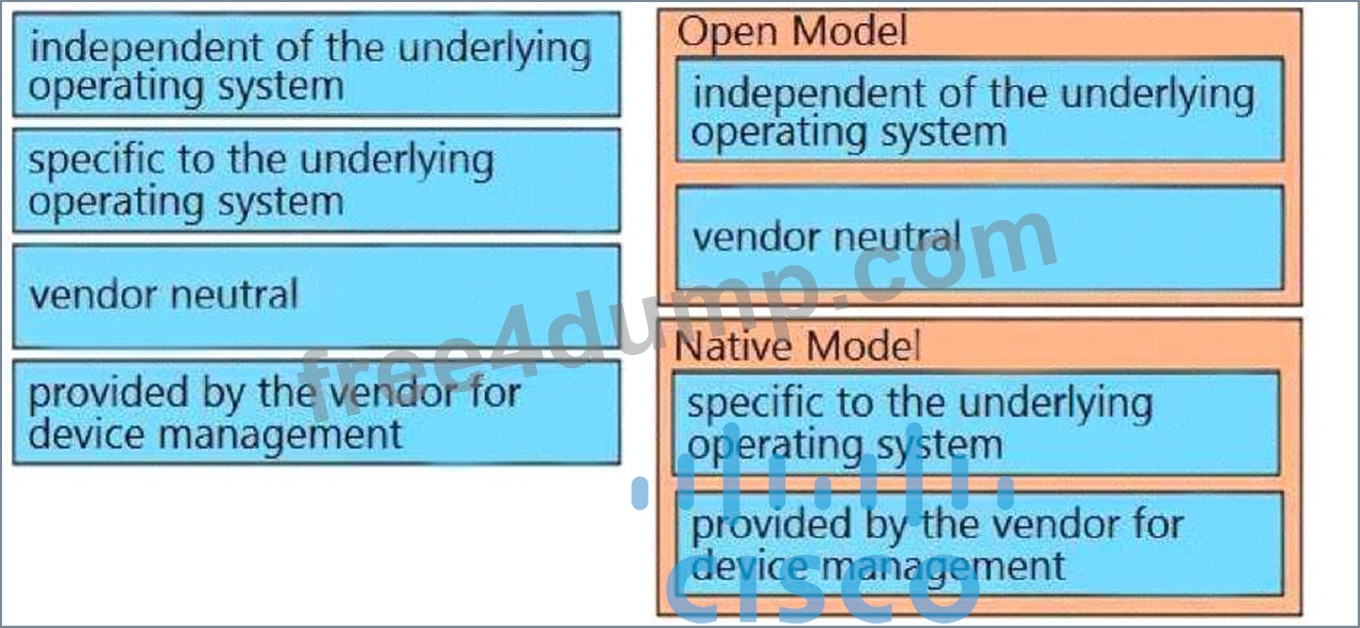
Drag and drop the characteristics from the left onto the Yang model they describe on the right.
Select and Place: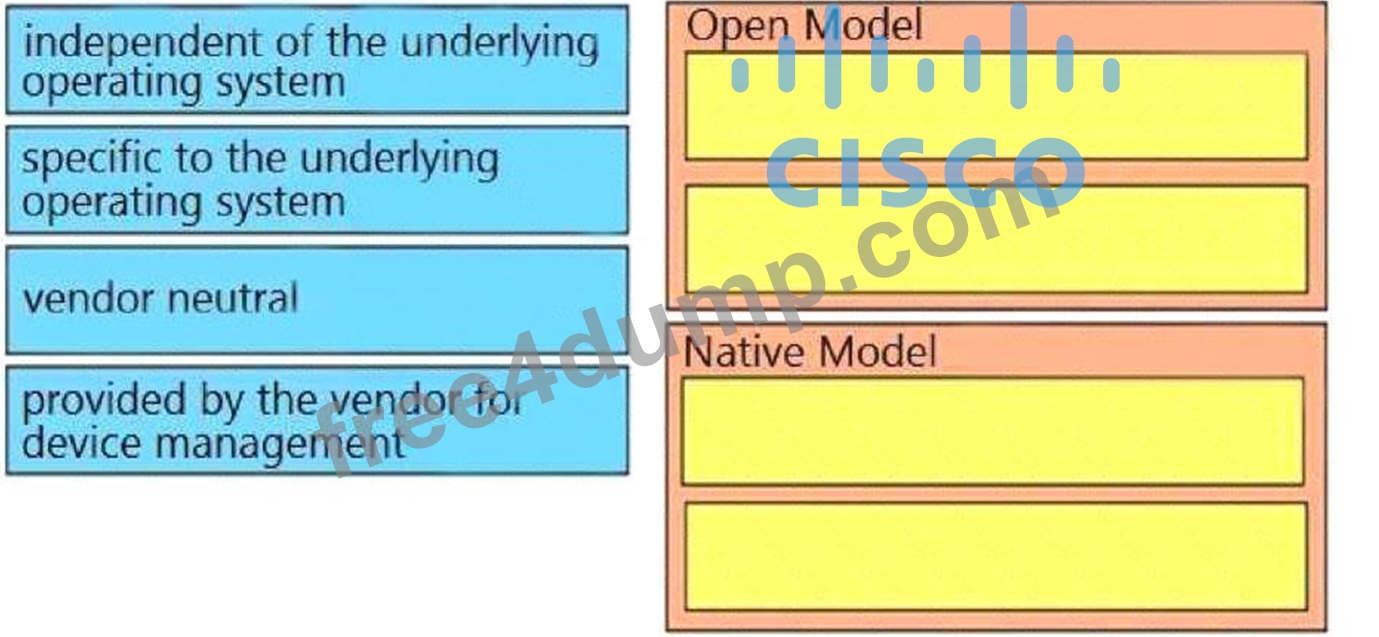
Answer:
Explanation: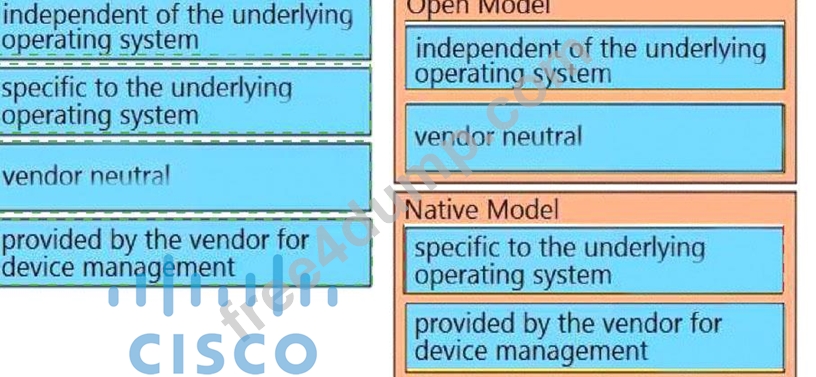
NEW QUESTION 33
Which technology provides a multichassis IP connection between VSS-enabled switches and downstream devices?
- A. MEC
- B. LACP
- C. BFD
- D. PAgP
- E. ICCP
- F. LAG
Answer: A
NEW QUESTION 34
Which PIM mode uses a shared tree only?
- A. bidirectional
- B. source-specific
- C. dense
- D. sparse
Answer: A
Explanation:
In bidirectional mode, traffic is routed only along a bidirectional shared tree that is rooted at the rendezvous point (RP) for the group https://www.cisco.com/c/en/us/td/docs/ios-xml/ios/ipmulti_pim/configuration/xe-16/imc-pim-xe-16-book/imc-tech-oview.html#GUID-51D0D6DF-E7F1-4A0E-8E31-D7ED464DF2AC
NEW QUESTION 35
An engineer must design an in-band management solution for a customer with branch sites. The solution must allow remote management of the branch sites using management protocols over an MPLS WAN. Queueing is implemented at the remote sites using these classes: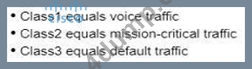
How must the solution prioritize the management traffic over the WAN?
- A. Mark the traffic with DSCP CS2 and map into Class2 with a minimum bandwidth assigned by reducing the bandwidth available to Class3
- B. Mark the traffic with DSCP EF and map into Class1 with a minimum bandwidth assigned by reducing the bandwidth available to Class2.
- C. Mark the traffic with DSCP CS6 and map into Class1 with a minimum bandwidth assigned by reducing the bandwidth available to Class2
- D. Mark the traffic with DSCP CS1 and map into Class2 with a minimum bandwidth assigned by reducing the bandwidth available to CIass3.
Answer: B
NEW QUESTION 36 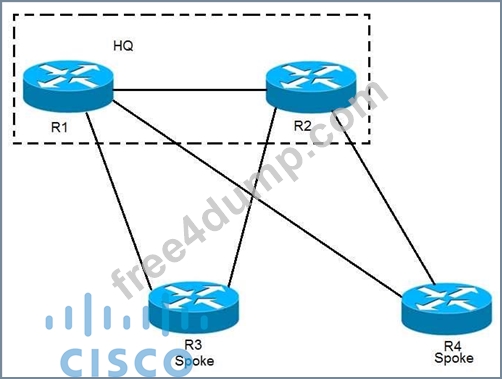
Refer to the exhibit. EIGRP has been configured on all links. The spoke nodes have been configured as EIGRP stubs, and the WAN links to R3 have higher bandwidth and lower delay than the links to R4. When a link failure occurs at the R1-R2 link, what happens to traffic on R1 that is destined for a subnet attached to R2?
- A. R1 forwards the traffic to R3, but R3 drops the traffic
- B. R1 has no route to R2 and drops the traffic
- C. R1 forwards the traffic to R3 in order to reach R2
- D. R1 load-balances across the paths through R3 and R4 to reach R2
Answer: C
NEW QUESTION 37
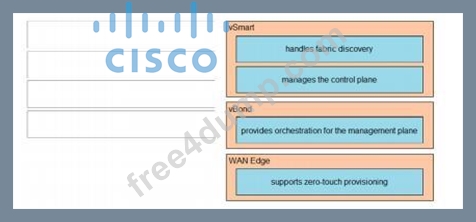
Drag and drop the properties from the left onto the Cisco SD-WAN components that perform them on the right.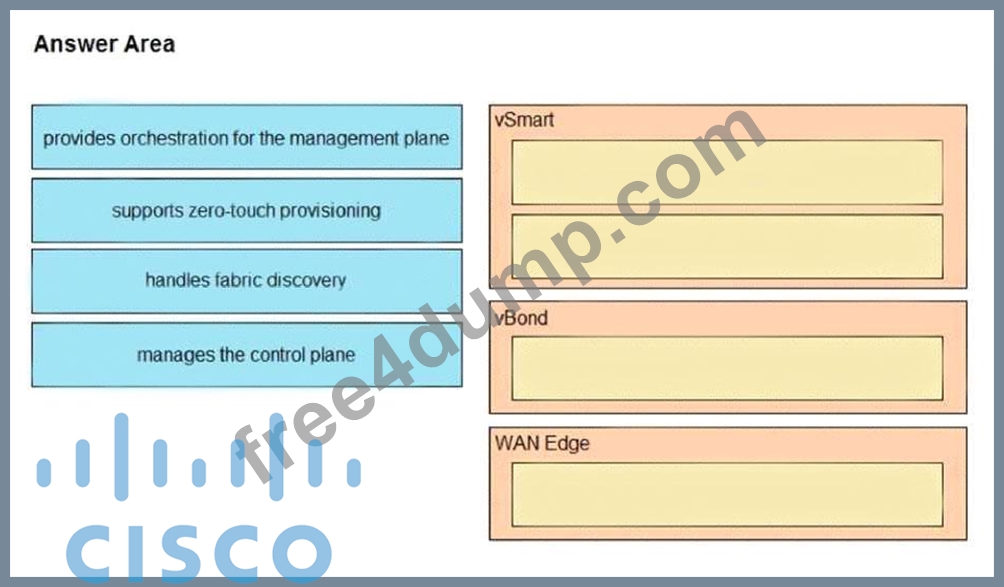
Answer:
Explanation: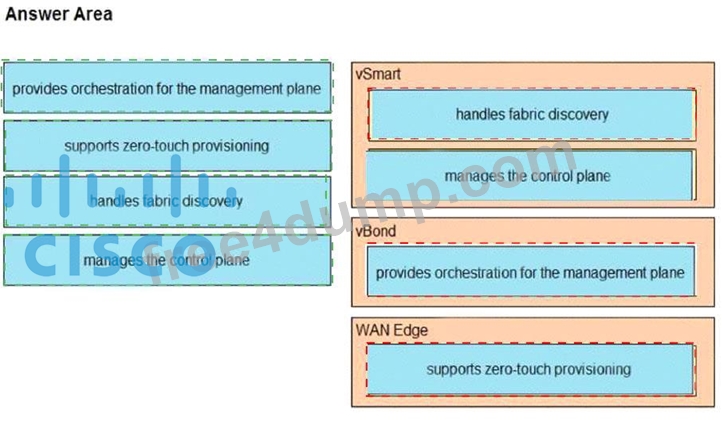
NEW QUESTION 38
Drag and drop the characteristics from the left onto the correct telemetry mode on the right.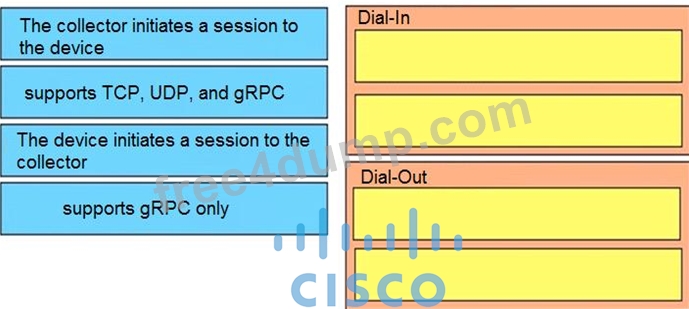
Answer:
Explanation: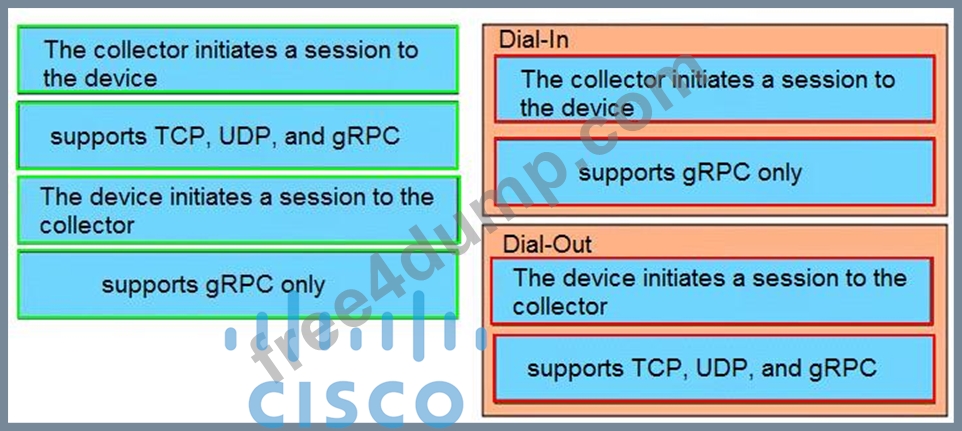
Explanation:
In a dial-in mode, the destination initiates a session to the router and subscribes to data to be streamed. Dialin mode is supported over gRPC in only 64-bit platforms In a dial-out mode, the router initiates a session to the destinations based on the subscription. All 64-bit IOS XR platforms (except for NCS 6000 series routers) support gRPC and TCP protocols. All 32-bit IOS XR platforms support only TCP.
Reference:
https://www.cisco.com/c/en/us/td/docs/iosxr/asr9000/telemetry/b-telemetry-cg-asr9000-61x/b-telemetry-cgasr9000-
61x_chapter_010.html#id_36445
NEW QUESTION 39
Which two border nodes are available in the Cisco SD-Access architecture? (Choose two.)
- A. anywhere border
- B. internal border
- C. intermediate border
- D. extended border
- E. edge border
Answer: A,B
Explanation:
Explanation
There are 3 types of border nodes in SD-Access:
External. Default exit from fabric with no specific routes injection
Internal. Gateway only for a set of networks, such as shared services prefixes Anywhere. Combination of external and internal functionality
NEW QUESTION 40
Which two statements about VRRP object tracking are true? (Choose two)
- A. The VRRP interface priority must be manually configured by the administrator
- B. The priority of a VRRP device can change in accordance with the up or down status of a VRRP object
- C. VRRP can track the status of interfaces and routes
- D. VRRP supports only interce tracking
- E. A VRRP group can track only one object at a time
Answer: B
NEW QUESTION 41
Which function are fabric intermediate nodes responsible for in an SD-Access Architecture?
- A. mapping EIDs to RLOCs
- B. encapsulating user traffic in a VXLAN header including the SGT
- C. transporting IP packets between edge nodes and border nodes
- D. registering new endpoints in the HTDB
Answer: C
Explanation:
Section: Advanced Enterprise Campus Networks
NEW QUESTION 42 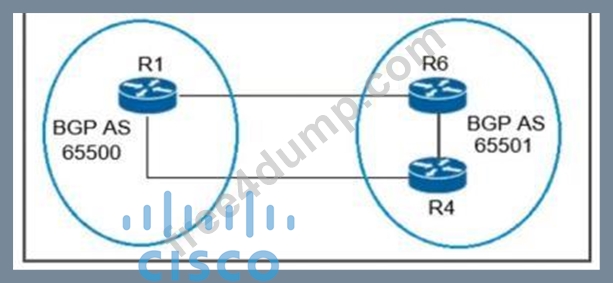
Refer to the exhibit. An architect must design a solution to connect the two ASs. To optimize bandwidth, the design will implement load sharing between router R6 and router R4. Which solution should the design include?
- A. Use update-source to specify the Loopback interface.
- B. Configure the eBGP TTL to support eBGP multihop.
- C. Use next-hop-serf attributes only for routes that are learned from eBGP peers.
- D. Use maximum-paths to install multiple paths in the routing table.
Answer: D
NEW QUESTION 43 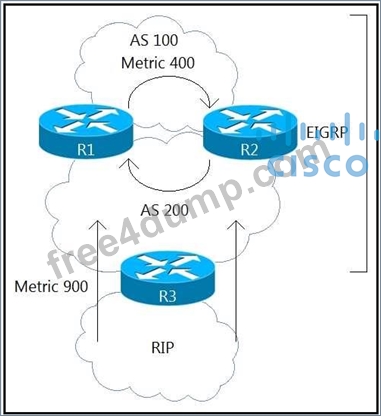
Refer to the exhibit. An architect must design a solution to connect the network behind R3 with the EIGRP network. Which mechanism should be included to avoid routing loops?
- A. summarization
- B. split horizon
- C. route tags
- D. down bit
Answer: C
Explanation:
Section: Advanced Addressing and Routing Solutions
NEW QUESTION 44
An organization is designing a detailed QoS plan that limits bandwidth to specific rates. Which two parameters are supported be the traffic policing feature? (Choose two.)
- A. bursting
- B. violating
- C. shaping
- D. conforming
- E. marking
Answer: C,E
NEW QUESTION 45
Which design consideration must be made when dual WAN Edge routers are deployed at a branch site?
- A. Use BGP AS-path prepending to influence egress traffic and use MED to influence ingress traffic from the branch.
- B. Configure BFD between WAN Edge routers to detect sub-second link failures.
- C. Traffic must be symmetrical as it egresses the WAN Edges and returns from remote sites for DPI to function properly.
- D. HSRP priorities must match the OMP routing policy to prefer one WAN Edge over the other.
Answer: A
Explanation:
Section: WAN for Enterprise Networks
NEW QUESTION 46
Which of the following features does GLBP provide, but not HSRP and VRRP? (Choose all that apply.)
- A. Support for interface tracking
- B. Support for multiple gateways
- C. Support for automatic load balancing
- D. Support for single active router
Answer: B,C
Explanation:
Support for automatic load balancing and support for multiple gateways are two features that are provided by Gateway Load Balancing Protocol (GLBP) but not by Hot Standby Routing Protocol (HSRP) or Virtual Router Redundancy Protocol (VRRP).
GLBP, HSRP, and VRRP provide a redundant and fault-tolerant solution in case of first-hop router failure in a network. The basic operation of these three protocols is the same. In all three protocols, a group of routers on the same LAN is formed. One of the routers is selected as the active router and another as the standby router.
The router with the highest priority is automatically selected as the active router. If the active router fails, the standby router assumes the responsibilities of the active router. The role of the active router is to forward the packets from the hosts to the virtual router (default gateway).
GLBP provides automatic load balancing between multiple routers by configuring multiple MAC addresses but a single virtual IP address. Every active virtual forwarder (AVF) in the group is configured with the virtual IP address but with different MAC addresses. All such AVFs can then participate in the packet-forwarding process. Multiple gateways then can share the load. On the contrary, HSRP and VRRP do not support automatic load balancing. Both these protocols require additional configuration on all the routers that need to load balance. The additional configuration involves using multiple groups on the routers or assignment of different default gateways for the hosts.
Note that GLBP and VRRP are supported by both Cisco and non-Cisco routers, whereas, HSRP is supported only by Cisco routers.
Single active router and interface tracking both are supported by GLBP, HSRP, and VRRP.
Objective:
Infrastructure Services
Sub-Objective:
Configure and verify first-hop redundancy protocols
References:
Home > End-of-Sale and End-of-Life Products > Cisco IOS Software Releases 12.2.T > Product Literature > White Papers > GLBP Gateway Load Balancing Protocol > Information About Gateway Load Balancing Protocol Home > Support > Technology Support > IP > IP Application Services > Design > Design Technotes > Hot Standby Router Protocol Features and Functionality > HSRP Background and Operations > HSRP Operation
NEW QUESTION 47
An engineer must design a solution to provide backup connectivity between two sites. The engineer plans to use an Internet connection but company policy requires the connection to be encrypted. Additionally, there are several applications that utilize multicast to deliver video streams between the sites. Which technology should the design include?
- A. GRE over IPsec
- B. GETVPN
- C. DMVPN
- D. IPsec direct encapsulation
Answer: A
NEW QUESTION 48
Refer to the exhibit. An architect must design an IP addressing scheme for a multisite network connected via a WAN transit. The campus site must accommodate 12,000 devices and the branch sites must accommodate 1,000 devices. Which address scheme optimizes network device resources, contains convergence events to the different blocks of the network, and ensures future growth of the network?
- A. * Campus: 10.0.0.0/20
Branch1: 10.0.64.0/21
Branch2: 10.0.128.0/21 - B. * Campus: 10.0.0.0/18
Branch1: 10.0.192.0/21
Branch2: 10.0.200.0/21 - C. * Campus: 10.0.0.0/10
Branch1: 10.64.0.0/10
Branch2: 10.128.0.0/10 - D. * Campus: 10.0.0.0/16
Branchi: 10.255.0.0/20
Branch2: 10.255.16.0/20
Answer: B
NEW QUESTION 49
......
Passing Key To Getting 300-420 Certified Exam Engine PDF: https://passleader.free4dump.com/300-420-real-dump.html