


[Full-Version] 2025 New AZ-104 Actual Exam Dumps, Microsoft Practice Test
Study HIGH Quality AZ-104 Free Study Guides and Exams Tutorials
NEW QUESTION # 454
You plan to deploy an Azure container instance by using the following Azure Resource Manager template.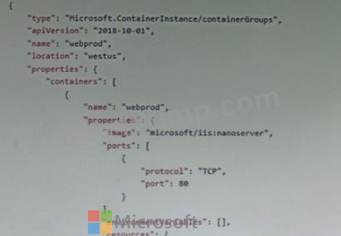


Use the drop-down menus to select the answer choice that completes each statement based on the information presented in the template.
Answer:
Explanation:
Explanation
Box 1: can connect to the container from any device
In the policy "osType": "window" refer that it will create a container in a container group that runs Windows but it won't block access depending on device type.
Box 2: the container will restart automatically
Docker provides restart policies to control whether your containers start automatically when they exit, or when Docker restarts. Restart policies ensure that linked containers are started in the correct order. Docker recommends that you use restart policies, and avoid using process managers to start containers.
on-failure : Restart the container if it exits due to an error, which manifests as a non-zero exit code.
As the flag is mentioned as "on-failure" in the policy, so it will restart automatically
Reference:
https://docs.microsoft.com/en-us/cli/azure/container?view=azure-cli-latest
https://docs.docker.com/config/containers/start-containers-automatically/
NEW QUESTION # 455
Hotspot Question
You have an Azure subscription that contains the resource groups shown in the following table.
RG1 contains the resources shown in the following table.
RG2 contains the resources shown in the following table.
You need to identify which resources you can move from RG1 to RG2, and which resources you can move from RG2 to RG1.
Which resources should you identify? To answer, select the appropriate options in the answer area.
NOTE: Each correct selection is worth one point.
Answer:
Explanation:
Explanation:
Box 1: IP1, VNET2, and storage1
Box 2: IP2, VNET2, and storage2
Locks are designed for any update or removal. In this case we want to move only, we are not deleting, and we are not changing anything in the resource.
NEW QUESTION # 456
You have an Azure subscription named Subscription1.
In Subscription1, you create an Azure web app named WebApp1. WebApp1 will access an external service that requires certificate authentication.
You plan to require the use of HTTPS to access WebApp1.
You need to upload certificates to WebApp1.
In which formats should you upload the certificate? To answer, select the appropriate options in the answer area.
NOTE: Each correct selection is worth one point.
Answer:
Explanation:
NEW QUESTION # 457
You have an Azure virtual machine that runs Windows Server 2019 and has the following configurations:
* Name: VM1
* Location: West US
* Connected to: VNET1
* Private IP address: 10.1.0.4
* Public IP address: 52.186.85.63
* DNS suffix in Windows Server: Adatum.com
You create the Azure DNS zones shown in the following table.
You need to identify which DNS zones you can link to VNET1 and the DNS zones to which VM1 can automatically register.
Which zones should you identify? To answer, select the appropriate options in the answer area.
Answer:
Explanation:
Reference:
https://docs.microsoft.com/en-us/azure/dns/private-dns-overview
NEW QUESTION # 458
You have an Azure subscription named Subcription1 that contains the storage accounts shown in the following table.
You plan 10 use the Azure Import/Export service to export data from Subscription1.
- A. storage2
- B. storage3
- C. storage4
- D. storage1
Answer: C
Explanation:
Explanation
Azure Import/Export service supports the following of storage accounts:
* Standard General Purpose v2 storage accounts (recommended for most scenarios)
* Blob Storage accounts
* General Purpose v1 storage accounts (both Classic or Azure Resource Manager deployments), Azure Import/Export service supports the following storage types
* Import supports Azure Blob storage and Azure File storage
* Export supports Azure Blob storage
Reference:
https://docs.microsoft.com/en-us/azure/storage/common/storage-import-export-requirements
NEW QUESTION # 459
You have an Azure subscription that contains the virtual networks shown in the following table.
The subscription contains the virtual machines shown in the following table.
Each virtual machine contains only a private IP address.
You create an Azure bastion for VNet1 as shown in the following exhibit.
For each of the following statements, select Yes if the statement is true. Otherwise, select No.
NOTE: Each correct selection is worth one point.
Answer:
Explanation:
NEW QUESTION # 460
You have an Azure subscription named Subscription1 that contains the following resource group:
* Name: RG1
* Region: West US
* Tag: "tag1": "value1"
You assign an Azure policy named Policy1 to Subscription1 by using the following configurations:
* Exclusions: None
* Policy definition: Append tag and its default value
* Assignment name: Policy1
* Parameters:
- Tag name: Tag2
- Tag value: Value2
After Policy1 is assigned, you create a storage account that has the following configurations:
* Name: storage1
* Location: West US
* Resource group: RG1
* Tags: "tag3": "value3"
You need to identify which tags are assigned to each resource.
What should you identify? To answer, select the appropriate options in the answer area.
NOTE: Each correct selection is worth one point.
Answer:
Explanation:
Explanation
Box 1: "tag1": "value1" only
Box 2: "tag2": "value2" and "tag3": "value3"
Tags applied to the resource group are not inherited by the resources in that resource group.
References:
https://docs.microsoft.com/en-us/azure/azure-resource-manager/resource-group-using-tags
NEW QUESTION # 461
You have an Azure subscription that contains the virtual networks shown in the following table.
You have the virtual machines shown in the following table.
You have the virtual network interfaces shown in the following table.
Server1 is a DNS server that contains the resources shown in the following table.
You have an Azure private DNS zone named contoso.com that has a virtual network link to VNET2 and the records shown in the following table.
For each of the following statements, select Yes if the statement is true. Otherwise, select No.
NOTE: Each correct selection is worth one point.
Answer:
Explanation:
A picture containing text, indoor, screenshot Description automatically generated
NEW QUESTION # 462
You have an Azure subscription that contains multiple virtual machines in the West US Azure region.
You need to use Traffic Analytics in Azure Network Watcher to monitor virtual machine traffic.
Which two resources should you create? Each correct answer presents part of the solution.
NOTE: Each correct selection is worth one point.
- A. a Log Analytics workspace
- B. a Microsoft Sentinel workspace
- C. an Azure Monitor workbook
- D. a Data Collection Rule (DCR) in Azure Monitor
- E. a storage account
Answer: A,D
Explanation:
A Log Analytics workspace - Traffic Analytics requires a Log Analytics workspace to store and analyze network traffic data.
A Data Collection Rule (DCR) in Azure Monitor - You need to create a Data Collection Rule within Azure Monitor to specify what data should be collected and sent to the Log Analytics workspace, including the network traffic data for Traffic Analytics.
NEW QUESTION # 463
Your on-premises network contains an Active Directory domain named adatum.com that is synced to Azure Active Directory (Azure AD). Password writeback is disabled.
In adatum.com, you create the users shown in the following table.
Which users must sign in from a computer joined to adatum.com?
- A. User2 only
- B. User1 only
- C. User1 and User3 only
- D. User1, User2, and User3
- E. User2 and User3 only
Answer: B
Explanation:
Explanation
Password writeback is a feature enabled with Azure AD Connect that allows password changes in the cloud to be written back to an existing on-premises directory in real time.
References:
https://docs.microsoft.com/en-us/azure/active-directory/authentication/concept-sspr-writeback
NEW QUESTION # 464
You have an Azure subscription named Subscription1 that contains the virtual networks in the following table.
Subscripton1 contains the virtual machines in the following table.
In Subscription1, you create a load balancer that has the following configurations:
* Name: LB1
* SKU: Basic
* Type: Internal
* Subnet: Subnet12
* Virtual network: VNET1
For each of the following statements, select Yes if the statement is true. Otherwise, select No.
NOTE: each correct selection is worth one point.
Answer:
Explanation:
Explanation
Statement 1 : Basic load balancer supports Virtual machine in a single Availability set or virtual machine scale set (VMSS) only . Hence this statement is correct.
Statement 2 : Basic load balancer supports Virtual machine in a single Availability set or virtual scale set only or one standalone VM. VM3 and VM4 are not part of any availability set or VMSS .Hence this statement is incorrect.
Statement 3 : Basic load balancer supports Virtual machine in a single Availability set or virtual scale set only or one standalone VM. VM5 and VM6 are not part of any availability set or VMSS .Hence this statement is incorrect.
References:
https://docs.microsoft.com/en-us/azure/load-balancer/load-balancer-overview
NEW QUESTION # 465
You have an Azure subscription that contains the resource groups shown in the following table.
RG1 contains the resources shown in the following table.

Answer:
Explanation:
NEW QUESTION # 466
You need to create storage5. The solution must support the planned changes.
Which type of storage account should you use, and which account should you configure as the destination storage account? To answer, select the appropriate options in the answer area.
NOTE: Each correct selection is worth one point.
Answer:
Explanation:
Explanation:
Reference:
https://docs.microsoft.com/en-us/azure/storage/blobs/object-replication-configure?tabs=portal
NEW QUESTION # 467
You have peering configured as shown in the following exhibit.
Use the drop-down menus to select the answer choice that completes each statement based on the information presented in the graphic.
NOTE: Each correct selection is worth one point.
Box 1: vNET6 only
Peering status to both VNet1 and Vnet2 are disconnected.
Box 2: delete peering1
Peering to Vnet1 is Enabled but disconnected. We need to update or re-create the remote peering to get it back to Initiated state.
Answer:
Explanation:
Reference:
https://blog.kloud.com.au/2018/10/19/address-space-maintenance-with-vnet-peering/
https://docs.microsoft.com/en-us/azure/virtual-network/virtual-network-manage-peering#requirements-andconstraints
NEW QUESTION # 468
You have an Azure subscription that contains a virtual machine named VM1.
You plan to deploy an Azure Monitor alert rule that will trigger an alert when CPU usage on VM1 exceeds 80 percent.
You need to ensure that the alert rule sends an email message to two users named User1 and User2.
What should you create for Azure Monitor?
- A. a distribution group
- B. a Microsoft 365 group
- C. an action group
- D. a mail-enabled security group
Answer: C
Explanation:
Explanation
An action group is a collection of notification preferences that can be used by Azure Monitor to send alerts to users or groups when an alert rule is triggered. An action group can include email recipients, SMS recipients, voice call recipients, webhook URLs, Azure functions, Logic Apps, and more. To send an email message to two users named User1 and User2 when CPU usage on VM1 exceeds 80 percent, you need to create an action group that contains their email addresses and associate it with the alert rule. References:
Create and manage action groups in the Azure portal
Create, view, and manage Metric alerts using Azure Monitor
NEW QUESTION # 469
Note: The question is included in a number of questions that depicts the identical set-up.
However, every question has a distinctive result. Establish if the solution satisfies the requirements.
Your company makes use of Multi-Factor Authentication for when users are not in the office. The Per Authentication option has been configured as the usage model.
After the acquisition of a smaller business and the addition of the new staff to Azure Active Directory (Azure AD) obtains a different company and adding the new employees to Azure Active Directory (Azure AD), you are informed that these employees should also make use of Multi- Factor Authentication.
To achieve this, the Per Enabled User setting must be set for the usage model.
Solution: You reconfigure the existing usage model via the Azure portal.
Does the solution meet the goal?
- A. No
- B. Yes
Answer: A
Explanation:
Since it is not possible to change the usage model of an existing provider as it is right now, you have to create a new one and reactivate your existing server with activation credentials from the new provider.
Reference:
https://365lab.net/2015/04/11/switch-usage-model-in-azure-multi-factor-authentication-server/
NEW QUESTION # 470
You need to meet the connection requirements for the New York office.
What should you do? To answer, select the appropriate options in the answer area.
NOTE: Each correct selection is worth one point.
Answer:
Explanation:
Explanation:
Box 1: Create a virtual network gateway and a local network gateway.
Azure VPN gateway. The VPN gateway service enables you to connect the VNet to the on-premises network through a VPN appliance. For more information, see Connect an on-premises network to a Microsoft Azure virtual network. The VPN gateway includes the following elements:
* Virtual network gateway. A resource that provides a virtual VPN appliance for the VNet. It is responsible for routing traffic from the on-premises network to the VNet.
* Local network gateway. An abstraction of the on-premises VPN appliance. Network traffic from the cloud application to the on-premises network is routed through this gateway.
* Connection. The connection has properties that specify the connection type (IPSec) and the key shared with the on-premises VPN appliance to encrypt traffic.
* Gateway subnet. The virtual network gateway is held in its own subnet, which is subject to various requirements, described in the Recommendations section below.
Box 2: Configure a site-to-site VPN connection
On premises create a site-to-site connection for the virtual network gateway and the local network gateway.
Scenario: Connect the New York office to VNet1 over the Internet by using an encrypted connection.
Incorrect Answers:
Azure ExpressRoute: Established between your network and Azure, through an ExpressRoute partner. This connection is private. Traffic does not go over the internet.
References:
https://docs.microsoft.com/en-us/azure/architecture/reference-architectures/hybrid-networking/vpn
NEW QUESTION # 471
You have the Azure virtual machines shown in the following table.
VNET1, VNET2, and VNET3 are peered.
VM4 has a DNS server that is authoritative for a zone named Contoso.com and contains the records shown in the following table.
VNET1 and VNET2 are linked to an Azure private DNS zone named Contoso.com that contains the records shown in the following table.
The virtual networks are configured to use the DNS servers shown in the following table.
For each of the following statements, select Yes if the statement is true. Otherwise, select No.
NOTE: Each correct selection is worth one point.
Answer:
Explanation:
NEW QUESTION # 472
You have an Azure subscription that contains the resources shown in the following table.
The Not allowed resource types Azure policy that has policy enforcement enabled is assigned to RG1 and uses the following parameters:
Microsoft.Network/virtualNetworks
Microsoft.Compute/virtualMachines
In RG1, you need to create a new virtual machine named VM2 which is connected toVNET1. What should you do first?
- A. Create an Azure Resource Manager template.
- B. Remove Microsoft.Compute/virtualMachines from the policy.
- C. Remove Microsoft. Network/virtualNetworks from the policy.
- D. AddasubnettoVNET1.
Answer: C
Explanation:
Explanation
To create a new virtual machine named VM2 which is connected to VNET1 in RG1, you need to remove Microsoft.Network/virtualNetworks from the policy. This is because the Not allowed resource types Azure policy denies the deployment of the specified resource types in the scope of the assignment. In this case, the policy is assigned to RG1 and uses the parameters Microsoft.Network/virtualNetworks and Microsoft.Compute/virtualMachines. This means that you cannot create or update any virtual networks or virtual machines in RG1. Therefore, to create VM2 and connect it to VNET1, you need to remove Microsoft.Network/virtualNetworks from the policy parameters. This will allow you to create or update virtual networks in RG1, but still prevent you from creating or updating virtual machines. Alternatively, you can also exclude VNET1 from the policy assignment scope, but this will affect the compliance of the policy for the entire virtual network.
References:
Not allowed resource types (Deny)
Create and manage policies to enforce compliance
NEW QUESTION # 473
Note: The question is included in a number of questions that depicts the identical set-up.
However, every question has a distinctive result. Establish if the solution satisfies the requirements.
Your company has a Microsoft SQL Server Always On availability group configured on their Azure virtual machines (VMs).
You need to configure an Azure internal load balancer as a listener for the availability group.
Solution: You set Session persistence to Client IP.
Does the solution meet the goal?
- A. No
- B. Yes
Answer: A
Explanation:
Session persistence ensures that a client will remain connected to the same server throughout a session or period of time. Because load balancing may, by default, send users to unique servers each time they connect, this can mean that complicated or repeated requests are slowed down.
Reference:
https://docs.microsoft.com/en-us/azure/load-balancer/distribution-mode-concepts#session- persistence
NEW QUESTION # 474
......
Get 100% Real Free Microsoft Azure Administrator Associate AZ-104 Sample Questions: https://passleader.free4dump.com/AZ-104-real-dump.html