


New (2023) Download free CKAD PDF for Linux Foundation Practice Tests
100% Free CKAD Files For passing the exam Quickly
Linux Foundation Certified Kubernetes Application Developer (CKAD) Certification Exam is a rigorous test designed to evaluate the expertise of developers working with Kubernetes. Kubernetes is an open-source container orchestration system that automates the deployment, scaling, and management of containerized applications. It is widely used by organizations to manage their cloud-native applications, and the demand for certified Kubernetes developers is increasing day by day. The CKAD certification exam validates the skills and knowledge of developers in designing, building, configuring, and deploying cloud-native applications on Kubernetes.
NEW QUESTION # 17
Context
Task:
Modify the existing Deployment named broker-deployment running in namespace quetzal so that its containers.
1) Run with user ID 30000 and
2) Privilege escalation is forbidden
The broker-deployment is manifest file can be found at:
Answer:
Explanation:
Solution:


NEW QUESTION # 18
Refer to Exhibit.
Context
It is always useful to look at the resources your applications are consuming in a cluster.
Task
* From the pods running in namespace cpu-stress , write the name only of the pod that is consuming the most CPU to file /opt/KDOBG030l/pod.txt, which has already been created.
Answer:
Explanation:
Solution:
NEW QUESTION # 19 
Task:
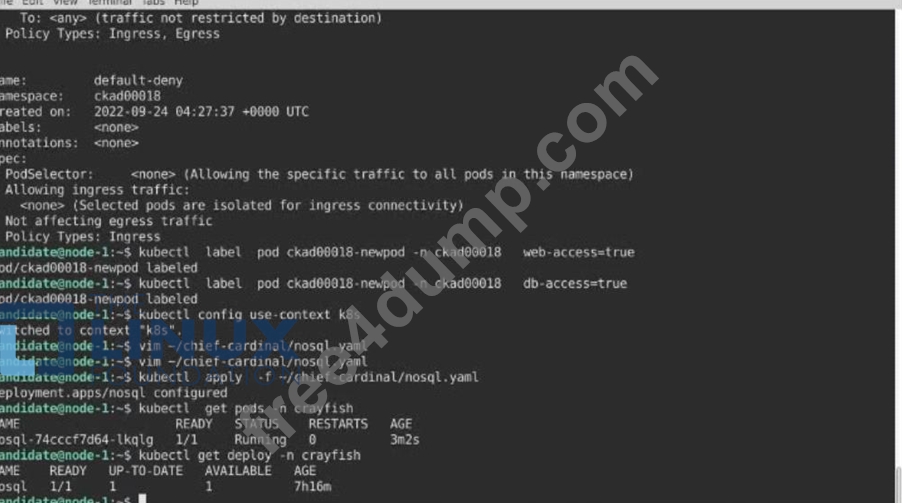
The pod for the Deployment named nosql in the craytisn namespace fails to start because its container runs out of resources.
Update the nosol Deployment so that the Pod:
1) Request 160M of memory for its Container
2) Limits the memory to half the maximum memory constraint set for the crayfah name space.
Answer:
Explanation:
See the solution below.
Explanation
Solution:


NEW QUESTION # 20
Context
Task
A deployment is falling on the cluster due to an incorrect image being specified. Locate the deployment, and fix the problem.
Answer:
Explanation:
create deploy hello-deploy --image=nginx --dry-run=client -o yaml > hello-deploy.yaml Update deployment image to nginx:1.17.4: kubectl set image deploy/hello-deploy nginx=nginx:1.17.4
NEW QUESTION # 21
Refer to Exhibit.
Context
Your application's namespace requires a specific service account to be used.
Task
Update the app-a deployment in the production namespace to run as the restrictedservice service account. The service account has already been created.
Answer:
Explanation:
Solution:
NEW QUESTION # 22
Refer to Exhibit.
Context
You are tasked to create a ConfigMap and consume the ConfigMap in a pod using a volume mount.
Task
Please complete the following:
* Create a ConfigMap named another-config containing the key/value pair: key4/value3
* start a pod named nginx-configmap containing a single container using the nginx image, and mount the key you just created into the pod under directory /also/a/path
Answer:
Explanation:
Solution:


NEW QUESTION # 23
Context
Task:
1) Create a secret named app-secret in the default namespace containing the following single key-value pair:
Key3: value1
2) Create a Pod named ngnix secret in the default namespace.Specify a single container using the nginx:stable image.
Add an environment variable named BEST_VARIABLE consuming the value of the secret key3.
Answer:
Explanation:
Solution:


NEW QUESTION # 24
Context
Context
Your application's namespace requires a specific service account to be used.
Task
Update the app-a deployment in the production namespace to run as the restrictedservice service account. The service account has already been created.
Answer:
Explanation:
Solution:
NEW QUESTION # 25
Exhibit:
Task
You are required to create a pod that requests a certain amount of CPU and memory, so it gets scheduled to-a node that has those resources available.
* Create a pod named nginx-resources in the pod-resources namespace that requests a minimum of 200m CPU and 1Gi memory for its container
* The pod should use the nginx image
* The pod-resources namespace has already been created
- A. Solution:


- B. Solution:

Answer: B
NEW QUESTION # 26
Task:
Create a Deployment named expose in the existing ckad00014 namespace running 6 replicas of a Pod. Specify a single container using the ifccncf/nginx: 1.13.7 image Add an environment variable named NGINX_PORT with the value 8001 to the container then expose port
8001
Answer:
Explanation:
See the solution below.
Explanation
Solution:
Text Description automatically generated
Text Description automatically generated
NEW QUESTION # 27
Context
Context
It is always useful to look at the resources your applications are consuming in a cluster.
Task
* From the pods running in namespace cpu-stress , write the name only of the pod that is consuming the most CPU to file /opt/KDOBG030l/pod.txt, which has already been created.
Answer:
Explanation:
Solution:
NEW QUESTION # 28
Refer to Exhibit.
Context
You are tasked to create a secret and consume the secret in a pod using environment variables as follow:
Task
* Create a secret named another-secret with a key/value pair; key1/value4
* Start an nginx pod named nginx-secret using container image nginx, and add an environment variable exposing the value of the secret key key 1, using COOL_VARIABLE as the name for the environment variable inside the pod
Answer:
Explanation:
Solution:


NEW QUESTION # 29
Context
Given a container that writes a log file in format A and a container that converts log files from format A to format B, create a deployment that runs both containers such that the log files from the first container are converted by the second container, emitting logs in format B.
Task:
* Create a deployment named deployment-xyz in the default namespace, that:
* Includes a primary
lfccncf/busybox:1 container, named logger-dev
* includes a sidecar Ifccncf/fluentd:v0.12 container, named adapter-zen
* Mounts a shared volume /tmp/log on both containers, which does not persist when the pod is deleted
* Instructs the logger-dev
container to run the command
which should output logs to /tmp/log/input.log in plain text format, with example values:
* The adapter-zen sidecar container should read /tmp/log/input.log and output the data to /tmp/log/output.* in Fluentd JSON format. Note that no knowledge of Fluentd is required to complete this task: all you will need to achieve this is to create the ConfigMap from the spec file provided at /opt/KDMC00102/fluentd-configma p.yaml , and mount that ConfigMap to /fluentd/etc in the adapter-zen sidecar container
Answer:
Explanation:
Solution:


NEW QUESTION # 30
Refer to Exhibit.
Task:
Create a Pod named nginx resources in the existing pod resources namespace.
Specify a single container using nginx:stable image.
Specify a resource request of 300m cpus and 1G1 of memory for the Pod's container.
Answer:
Explanation:
Solution:


NEW QUESTION # 31 
Task
A deployment is falling on the cluster due to an incorrect image being specified. Locate the deployment, and fix the problem.
Answer:
Explanation:
See the solution below
Explanation
create deploy hello-deploy --image=nginx --dry-run=client -o yaml > hello-deploy.yaml Update deployment image to nginx:1.17.4: kubectl set image deploy/hello-deploy nginx=nginx:1.17.4
NEW QUESTION # 32 
Context
As a Kubernetes application developer you will often find yourself needing to update a running application.
Task
Please complete the following:
* Update the app deployment in the kdpd00202 namespace with a maxSurge of 5% and a maxUnavailable of
2%
* Perform a rolling update of the web1 deployment, changing the Ifccncf/ngmx image version to 1.13
* Roll back the app deployment to the previous version
Answer:
Explanation:
See the solution below.
Explanation
Solution:


NEW QUESTION # 33
Refer to Exhibit.
Set Configuration Context:
[student@node-1] $ | kubectl
Config use-context k8s
Context
A pod is running on the cluster but it is not responding.
Task
The desired behavior is to have Kubemetes restart the pod when an endpoint returns an HTTP 500 on the /healthz endpoint. The service, probe-pod, should never send traffic to the pod while it is failing. Please complete the following:
* The application has an endpoint, /started, that will indicate if it can accept traffic by returning an HTTP 200. If the endpoint returns an HTTP 500, the application has not yet finished initialization.
* The application has another endpoint /healthz that will indicate if the application is still working as expected by returning an HTTP 200. If the endpoint returns an HTTP 500 the application is no longer responsive.
* Configure the probe-pod pod provided to use these endpoints
* The probes should use port 8080
Answer:
Explanation:
Solution:
To have Kubernetes automatically restart a pod when an endpoint returns an HTTP 500 on the /healthz endpoint, you will need to configure liveness and readiness probes on the pod.
First, you will need to create a livenessProbe and a readinessProbe in the pod's definition yaml file. The livenessProbe will check the /healthz endpoint, and if it returns an HTTP 500, the pod will be restarted. The readinessProbe will check the /started endpoint, and if it returns an HTTP 500, the pod will not receive traffic.
Here's an example of how you can configure the liveness and readiness probes in the pod definition yaml file:
apiVersion: v1
kind: Pod
metadata:
name: probe-pod
spec:
containers:
- name: probe-pod
image: <image-name>
ports:
- containerPort: 8080
livenessProbe:
httpGet:
path: /healthz
port: 8080
initialDelaySeconds: 15
periodSeconds: 10
failureThreshold: 3
readinessProbe:
httpGet:
path: /started
port: 8080
initialDelaySeconds: 15
periodSeconds: 10
failureThreshold: 3
The httpGet specifies the endpoint to check and the port to use. The initialDelaySeconds is the amount of time the pod will wait before starting the probe. periodSeconds is the amount of time between each probe check, and the failureThreshold is the number of failed probes before the pod is considered unresponsive.
You can use kubectl to create the pod by running the following command:
kubectl apply -f <filename>.yaml
Once the pod is created, Kubernetes will start monitoring it using the configured liveness and readiness probes. If the /healthz endpoint returns an HTTP 500, the pod will be restarted. If the /started endpoint returns an HTTP 500, the pod will not receive traffic.
Please note that if the failure threshold is set to 3, it means that if the probe fails 3 times consecutively it will be considered as a failure.
The above configuration assumes that the application is running on port 8080 and the endpoints are available on the same port.
NEW QUESTION # 34
Refer to Exhibit.
Task:
1) Fix any API depreciation issues in the manifest file -/credible-mite/www.yaml so that this application can be deployed on cluster K8s.
2) Deploy the application specified in the updated manifest file -/credible-mite/www.yaml in namespace cobra
Answer:
Explanation:
Solution:


NEW QUESTION # 35
Context
Task:
Create a Deployment named expose in the existing ckad00014 namespace running 6 replicas of a Pod. Specify a single container using the ifccncf/nginx: 1.13.7 image Add an environment variable named NGINX_PORT with the value 8001 to the container then expose port 8001
Answer:
Explanation:
Solution:


NEW QUESTION # 36
Context
Context
You are tasked to create a ConfigMap and consume the ConfigMap in a pod using a volume mount.
Task
Please complete the following:
* Create a ConfigMap named another-config containing the key/value pair: key4/value3
* start a pod named nginx-configmap containing a single container using the nginx image, and mount the key you just created into the pod under directory /also/a/path
Answer:
Explanation:
Solution:


NEW QUESTION # 37
Refer to Exhibit.
Task:
1) First update the Deployment cka00017-deployment in the ckad00017 namespace:
*To run 2 replicas of the pod
*Add the following label on the pod:
Role userUI
2) Next, Create a NodePort Service named cherry in the ckad00017 nmespace exposing the ckad00017-deployment Deployment on TCP port 8888
Answer:
Explanation:
Solution:


NEW QUESTION # 38 
Context
A web application requires a specific version of redis to be used as a cache.
Task
Create a pod with the following characteristics, and leave it running when complete:
* The pod must run in the web namespace.
The namespace has already been created
* The name of the pod should be cache
* Use the Ifccncf/redis image with the 3.2 tag
* Expose port 6379
Answer:
Explanation:
See the solution below.
Explanation
Solution:
NEW QUESTION # 39
Context
Context
A project that you are working on has a requirement for persistent data to be available.
Task
To facilitate this, perform the following tasks:
* Create a file on node sk8s-node-0 at /opt/KDSP00101/data/index.html with the content Acct=Finance
* Create a PersistentVolume named task-pv-volume using hostPath and allocate 1Gi to it, specifying that the volume is at /opt/KDSP00101/data on the cluster's node. The configuration should specify the access mode of ReadWriteOnce . It should define the StorageClass name exam for the PersistentVolume , which will be used to bind PersistentVolumeClaim requests to this PersistenetVolume.
* Create a PefsissentVolumeClaim named task-pv-claim that requests a volume of at least 100Mi and specifies an access mode of ReadWriteOnce
* Create a pod that uses the PersistentVolmeClaim as a volume with a label app: my-storage-app mounting the resulting volume to a mountPath /usr/share/nginx/html inside the pod

Answer:
Explanation:
Solution:


NEW QUESTION # 40
Context
Task:
The pod for the Deployment named nosql in the craytisn namespace fails to start because its container runs out of resources.
Update the nosol Deployment so that the Pod:
1) Request 160M of memory for its Container
2) Limits the memory to half the maximum memory constraint set for the crayfah name space.
Answer:
Explanation:
Solution:


NEW QUESTION # 41
......
CKAD Premium Exam Engine - Download Free PDF Questions: https://passleader.free4dump.com/CKAD-real-dump.html