


VMA Exam Questions - Real & Updated Questions PDF
Pass Guaranteed Quiz 2026 Realistic Verified Free SAVE International
NEW QUESTION # 10
The Value Methodology is:
- A. A step-by-step design review to improve value.
- B. A suggestion program to improve value.
- C. A cost reduction exercise to improve value.
- D. An eight-phase process to improve value.
Answer: A
Explanation:
Value Methodology (VM), as defined by SAVE International in the Value Methodology Fundamentals 1 (VMF 1) course, is a systematic, step-by-step approach to improve the value of a project, product, or process by optimizing the function-to-cost ratio. According to SAVE International's Value Methodology Standard, VM is described as "a systematic and structured approach for improving projects, products, and processes...
to achieve the optimum balance between function, performance, quality, safety, and cost." The VM Job Plan, a core component of VM, involves a step-by-step process (six phases: Information, Function Analysis, Creative, Evaluation, Development, and Presentation) that can be likened to a design review because it evaluates and enhances the design or process to improve value.
* Option A (suggestion program) is incorrect because VM is not merely about collecting suggestions; it is a structured methodology with defined phases and tools like function analysis.
* Option B (cost reduction exercise) is incorrect because VM focuses on improving value, not just reducing costs-cost reduction may occur, but only if it does not compromise essential functions.
* Option C (step-by-step design review) aligns with VM's systematic nature, as the Job Plan reviews and improves designs or processes through structured phases, making it the best fit.
* Option D (eight-phase process) is incorrect because the VM Job Plan has six phases, not eight, as established in SAVE International's standards.
NEW QUESTION # 11
The VM Job Plan provides a structured sequence of phases designed to leverage which of the following types of thinking?
- A. Convergent and divergent
- B. Critical and divergent
- C. Divergent and abstract
- D. Convergent and abstract
Answer: A
Explanation:
The Value Methodology (VM) Job Plan, as outlined in the VMF 1 course (Core Competency #3: Value Methodology Job Plan), is a structured sequence of six phases designed to leverage bothdivergentand convergentthinking. According to SAVE International's Value Methodology Standard, "the VM Job Plan alternates between divergent thinking (to generate a wide range of ideas) and convergent thinking (to narrow down and refine those ideas)." Divergent thinking is used in the Creative Phase to brainstorm as many ideas as possible without judgment, while convergent thinking is applied in the Evaluation and Development Phases to analyze, select, and refine the best ideas into actionable proposals. This combination ensures a balance between creativity and practicality, maximizing value improvement.
* Option A (Divergent and abstract) is incorrect because, while divergent thinking is used, "abstract" is not a specific type of thinking emphasized in the VM Job Plan.
* Option B (Convergent and abstract) is incorrect because it omits divergent thinking, which is critical in the Creative Phase.
* Option C (Critical and divergent) is incorrect because, while critical thinking is involved in Evaluation, the VM Job Plan specifically emphasizes convergent thinking to narrow down ideas.
* Option D (Convergent and divergent) is correct, as it captures the dual thinking types leveraged across the VM Job Plan phases.
:
SAVE International, "Value Methodology Standard and Body of Knowledge," available athttps://www.value- eng.org, detailing the use of divergent and convergent thinking in the VM Job Plan.
SAVE International, VMF 1 Core Competency #3 (Value Methodology Job Plan), emphasizing the balance of divergent and convergent thinking.
NEW QUESTION # 12
In which phases of the VM Job Plan does the VM study team use convergent thinking?
- A. Creativity, Evaluation, Development
- B. Information, Function Analysis, Creativity
- C. Function Analysis, Creativity, Evaluation
- D. Evaluation, Development, Presentation
Answer: D
Explanation:
The Value Methodology (VM) Job Plan leverages both divergent and convergent thinking, as taught in the VMF 1 course (Core Competency #3: Value Methodology Job Plan). According to SAVE International's Value Methodology Standard, "convergent thinking is used to narrow down and refine ideas, focusing on analysis, selection, and implementation, while divergent thinking generates a wide range of ideas." The VM Job Plan's six phases are: Information, Function Analysis, Creativity, Evaluation, Development, and Presentation. Convergent thinking is applied in:
* Evaluation Phase: The team narrows down ideas using filters (Coarse, Medium, Fine, as in Question
33) and evaluation matrices, selecting the best ones.
* Development Phase: The team refines selected ideas into actionable proposals, focusing on feasibility and cost.
* Presentation Phase: The team consolidates proposals into a final recommendation, ensuring clarity and alignment with stakeholder needs.
Divergent thinking is primarily used in the Creativity Phase, while Information and Function Analysis involve analytical thinking but not necessarily convergent thinking in the same sense (they focus on understanding and defining, not narrowing down).
* Option A (Creativity, Evaluation, Development) is incorrect because Creativity uses divergent thinking, not convergent.
* Option B (Information, Function Analysis, Creativity) is incorrect because none of these phases primarily use convergent thinking; Creativity is divergent.
* Option C (Evaluation, Development, Presentation) is correct, as these phases involve convergent thinking to narrow down, refine, and finalize ideas.
* Option D (Function Analysis, Creativity, Evaluation) is incorrect because Function Analysis and Creativity do not primarily use convergent thinking.
:
SAVE International, "Value Methodology Standard and Body of Knowledge," available athttps://www.value- eng.org, detailing the use of convergent thinking in Evaluation, Development, and Presentation.
SAVE International, VMF 1 Core Competency #3 (Value Methodology Job Plan), emphasizing thinking types across phases (consistent with Question 22).
NEW QUESTION # 13
Which of the following are tasks during the development of VM proposals? (Choose 3 answers)
- A. Assess time and schedule impacts
- B. Validate the proposal
- C. State the disposition of the proposal
- D. Address technical feasibility
- E. Determine costs
Answer: A,D,E
Explanation:
The Development Phase of the Value Methodology (VM) Job Plan involves refining selected ideas into actionable proposals, as taught in the VMF 1 course (Core Competency #3: Value Methodology Job Plan).
According to SAVE International's Value Methodology Standard, "during the Development Phase, the VM team develops proposals by addressing technical feasibility, assessing time and schedule impacts, determining costs, identifying risks, and providing implementation plans." These tasks ensure that proposals are practical, cost-effective, and ready for presentation to stakeholders.
* A. Address technical feasibility: Correct, as the team must ensure the proposal can be implemented technically (e.g., does the design work?).
* B. Assess time and schedule impacts: Correct, as the team evaluates how the proposal affects the project timeline (e.g., delays or accelerations).
* D. Determine costs: Correct, as cost modeling is a key task (as noted in Question 9), providing stakeholders with financial impacts of the proposal.
* C. State the disposition of the proposal: Incorrect, as stating the disposition (e.g., accepted, rejected) occurs after the Presentation Phase, when stakeholders decide on the proposal, not during Development.
* E. Validate the proposal: Incorrect, as validation (e.g., testing or final confirmation) typically occurs during implementation or post-study, not during Development, which focuses on creating the proposal.
:
SAVE International, "Value Methodology Standard and Body of Knowledge," available athttps://www.value- eng.org, detailing tasks in the Development Phase like technical feasibility, time impacts, and cost determination.
SAVE International, VMF 1 Core Competency #3 (Value Methodology Job Plan), emphasizing Development Phase tasks (consistent with Question 9).
NEW QUESTION # 14
Which type of value is the sum of labor, material, and other resources required to produce the subject?
- A. Cost Value
- B. Exchange Value
- C. Use Value
- D. Esteem Value
Answer: A
Explanation:
In Value Methodology, value is defined as the relationship between function and cost (value = function/cost), and different types of value are analyzed to assess worth, as taught in the VMF 1 course (Core Competency
#4: Cost Analysis). According to SAVE International's Value Methodology Standard, the types of value include:
* Cost Value: "The sum of labor, material, overhead, and other resources required to produce the subject." It represents the actual cost to create or deliver the product or system.
* Use Value: The value of the functions the subject performs (e.g., what it does for the user).
* Esteem Value: The value associated with prestige, aesthetics, or desirability (e.g., brand value).
* Exchange Value: The value of the subject in terms of what it can be exchanged for (e.g., market value).
The question asks for the type of value that is the sum of labor, material, and other resources, which directly matches the definition ofCost Value. For example, the cost value of a car includes the costs of its parts, labor to assemble it, and overhead expenses.
* Option A (Esteem Value) is incorrect because esteem value relates to subjective desirability, not production costs.
* Option B (Exchange Value) is incorrect because exchange value is the market value, not the cost to produce.
* Option C (Use Value) is incorrect because use value reflects the functional utility, not the resource costs.
* Option D (Cost Value) is correct, as it is defined as the sum of resources required to produce the subject.
:
SAVE International, "Value Methodology Standard and Body of Knowledge," available athttps://www.value- eng.org, defining Cost Value as the sum of production resources.
SAVE International, VMF 1 Core Competency #4 (Cost Analysis), explaining types of value, including Cost Value, in the context of VM studies.
NEW QUESTION # 15
Which of the following best describes a VM study?
- A. Is considered a business improvement best practice
- B. Is undertaken after the design is completed
- C. Must be led by a Certified Value Specialist
- D. It is a structured effort using the VM process to improve value
Answer: D
Explanation:
A Value Methodology (VM) study is a structured effort that applies the VM process to improve the value of a project, product, or process by optimizing the function-to-cost ratio. According to SAVE International's Value Methodology Standard, a VM study is defined as "a systematic application of recognized techniques by a multi-disciplined team to identify the functions of a project or process, establish a worth for each function, and develop alternatives to achieve those functions at the lowest overall cost while maintaining performance." The VMF 1 course emphasizes that a VM study follows the six-phase VM Job Plan (Information, Function Analysis, Creative, Evaluation, Development, and Presentation) to systematically improve value, making it a structured effort.
* Option A (structured effort using the VM process) directly aligns with SAVE International's definition of a VM study, focusing on the systematic application of the VM process to enhance value.
* Option B (must be led by a Certified Value Specialist) is incorrect because, while a Certified Value Specialist (CVS) often leads VM studies, the VMF 1 course and VMA certification allow non-CVS team members to participate in and contribute to VM studies under guidance, meaning it's not a requirement.
* Option C (undertaken after the design is completed) is incorrect because VM studies can be conducted at various stages of a project lifecycle-concept, design, or implementation-not only after the design is completed. The VMF 1 course highlights that early application of VM yields the greatest benefits.
* Option D (business improvement best practice) is a broader statement and not specific to the definition of a VM study, though VM can contribute to business improvements. It does not best describe a VM study compared to Option A.
:
SAVE International, "Value Methodology Standard and Body of Knowledge," available athttps://www.value- eng.org, defining a VM study as a structured process to improve value.
SAVE International, "Value Methodology Associate (VMA) Certification,"https://www.value-eng.org/page
/VMA, referencing VMF 1 Core Competency #1 (Value Methodology Overview).
NEW QUESTION # 16
Which are the three main characteristics of the Value Methodology?
- A. Function Analysis, brainstorming, teamwork
- B. Multidisciplinary team, cost reduction, function improvement
- C. Systematic process, multidisciplinary team, qualified VM facilitator
- D. Systematic process, function analysis, CVS
Answer: C
Explanation:
Value Methodology (VM) is defined by SAVE International in its Value Methodology Standard as "a systematic process that uses a structured Job Plan to improve the value of projects, products, or processes by analyzing their functions and identifying opportunities to achieve required functions at the lowest total cost without compromising quality or performance" (as noted in Question 23). The VMF 1 course (Core Competency #1: Value Methodology Overview) highlights three main characteristics that define VM:
* Systematic process: VM follows a methodical, step-by-step approach (the VM Job Plan) to ensure consistency and effectiveness.
* Multidisciplinary team: VM studies are conducted by a diverse team with varied expertise to bring different perspectives (as emphasized in Question 24).
* Qualified VM facilitator: A facilitator trained in VM (often, but not always, a Certified Value Specialist) ensures the process is applied correctly and the team achieves optimal results.
While a Certified Value Specialist (CVS) is often involved, the broader characteristic is a qualified VM facilitator, as not all studies require a CVS (as noted in Question 4).
* Option A (Systematic process, function analysis, CVS) is incorrect because, while systematic process and function analysis are key, a CVS is not a defining characteristic; a qualified facilitator is more broadly applicable.
* Option B (Function Analysis, brainstorming, teamwork) is incorrect because these are components or activities within VM, not the main characteristics that define the methodology.
* Option C (Systematic process, multidisciplinary team, qualified VM facilitator) is correct, as it captures the three core characteristics of VM per SAVE International's standards.
* Option D (Multidisciplinary team, cost reduction, function improvement) is incorrect because cost reduction and function improvement are outcomes of VM, not defining characteristics; the systematic process and facilitation are more fundamental.
:
SAVE International, "Value Methodology Standard and Body of Knowledge," available athttps://www.value- eng.org, defining VM as a systematic process with a multidisciplinary team and facilitated approach.
SAVE International, VMF 1 Core Competency #1 (Value Methodology Overview), emphasizing the systematic, team-based, and facilitated nature of VM (consistent with Questions 23 and 24).
NEW QUESTION # 17
Which function is located to the left of the left vertical line in a FAST diagram?
- A. Secondary Function
- B. Lower Order Function
- C. Higher Order Function
- D. Basic Function
Answer: C
Explanation:
The Function Analysis System Technique (FAST) diagram is a key tool in Value Methodology's Function Analysis phase, as taught in the VMF 1 course (Core Competency #2). FAST diagrams map the relationships between functions, with the horizontal axis showing the "how-why" logic (critical path) and vertical lines called scope lines defining the study's boundaries. According to SAVE International's Value Methodology Standard, "the left vertical line in a FAST diagram is a scope line, and the function immediately to its right is typically the higher-order function, which represents the overarching goal or need for the system." The functionto the leftof the left scope line is outside the study's scope and often represents an even broader objective or external assumption that drives the higher-order function. However, in standard FAST diagramming, thehigher-order functionis the closest function to the left scope line within the scope, and functions to the left of the scope line (e.g., P in the diagram from Question 30) are external.
In the context of the VMA exam and VMF 1, the question likely tests the understanding of the higher-order function's position relative to the scope line. As established in Question 18, Function E (just inside the left scope line B) is the higher-order function. Functions to the left of the left scope line (e.g., P) are typically external assumptions or broader objectives, but the options provided (A, B, C, D) refer to standard function classifications within the FAST framework. Thehigher-order function(C) is the most relevant choice, as it is the function closest to the left scope line within the study's scope, and the question may be interpreted as asking for the function type associated with that position.
* Option A (Basic Function) is incorrect because the basic function is typically more central on the critical path, not at the far left.
* Option B (Secondary Function) is incorrect because secondary functions are vertical (supporting the critical path), not on the main path near the left scope line.
* Option C (Higher Order Function) is correct, as the higher-order function is located just to the right of the left scope line (e.g., Function E), and the question may be interpreted in this context based on standard FAST conventions.
* Option D (Lower Order Function) is incorrect because lower-order functions are to the right of the basic function, representing more specific outcomes, not near the left scope line.
:
SAVE International, VMF 1 Core Competency #2 (Function Analysis), defining the position of the higher- order function in FAST diagrams.
SAVE International, "Value Methodology Standard," section on Function Analysis, describing FAST diagramming conventions, including the role of scope lines and higher-order functions.
NEW QUESTION # 18
Risks associated with a project, product, or process typically impact:
- A. Resources, regulations, or time
- B. Time, function, or attributes
- C. Cost, requirements, or results
- D. Schedule, cost, or performance
Answer: D
Explanation:
Risk management is a critical aspect of Implementation Planning in Value Methodology (VM), as it ensures that VM proposals can be successfully executed, as taught in the VMF 1 course (Core Competency #8:
Implementation Planning). According to SAVE International's Value Methodology Standard, "risks associated with a project, product, or process typically impact schedule, cost, or performance." This is often referred to as the "project management triangle" or "triple constraint," a fundamental concept in project management that VM adopts when assessing risks during the Development and Presentation Phases.
* Schedule: Risks that cause delays (e.g., late delivery of materials).
* Cost: Risks that increase expenses (e.g., unexpected cost overruns).
* Performance: Risks that affect quality or functionality (e.g., a proposed solution failing to meet requirements).
The VMF 1 curriculum emphasizes that VM teams must identify and mitigate risks in these three areas to ensure the feasibility of their recommendations, making this the most relevant framework for understanding risk impacts in a VM context.
* Option A (Schedule, cost, or performance) is correct, as it directly aligns with the standard risk impact areas in VM and project management.
* Option B (Cost, requirements, or results) is incorrect because, while cost is relevant, "requirements" and "results" are less specific than "schedule" and "performance" in the context of VM risk management.
* Option C (Resources, regulations, or time) is incorrect because, while time (schedule) is relevant, resources and regulations are more specific factors that contribute to broader impacts on schedule, cost, or performance.
* Option D (Time, function, or attributes) is incorrect because, while time (schedule) is relevant,
"function" and "attributes" are not standard risk impact categories in VM; performance is the broader term used.
:
SAVE International, "Value Methodology Standard and Body of Knowledge," available athttps://www.value- eng.org, section on risk management, referencing the impact of risks on schedule, cost, and performance.
SAVE International, VMF 1 Core Competency #8 (Implementation Planning), emphasizing the project management triangle (schedule, cost, performance) in risk assessment.
NEW QUESTION # 19
Which of the following techniques involves capturing input from multiple customers and stakeholders at the same time?
- A. Surveys
- B. Questionnaires
- C. Interviews
- D. Focus panels
Answer: D
Explanation:
In Value Methodology (VM), gathering input from customers and stakeholders is a key activity, particularly during the Information Phase of the VM Job Plan, as taught in the VMF 1 course (Core Competency #3:
Value Methodology Job Plan). According to SAVE International's Value Methodology Standard, various techniques are used to collect stakeholder input, including interviews, questionnaires, surveys, and focus panels. The standard defines these as follows:
* Interviews: One-on-one discussions with individual stakeholders to gather detailed insights.
* Questionnaires: Written sets of questions distributed to stakeholders, typically completed individually.
* Surveys: Similar to questionnaires, often distributed to a larger group, with responses collected individually.
* Focus panels: Group discussions involving multiple customers and stakeholders simultaneously, designed to capture collective input and foster dialogue.
The question specifies a technique that involves capturing input "at the same time" from multiple customers and stakeholders, which aligns with the definition offocus panels. Focus panels (or focus groups) bring together diverse stakeholders in a single session to discuss needs, preferences, and concerns, allowing for real- time interaction and consensus-building, which is particularly useful in VM studies to understand project objectives and constraints.
* Option A (Interviews) is incorrect because interviews are typically conducted one-on-one, not with multiple stakeholders simultaneously.
* Option B (Questionnaires) is incorrect because questionnaires are completed individually, not in a group setting at the same time.
* Option C (Surveys) is incorrect because surveys are also completed individually, often asynchronously, not at the same time.
* Option D (Focus panels) is correct, as it involves capturing input from multiple stakeholders simultaneously in a group setting.
:
SAVE International, "Value Methodology Standard and Body of Knowledge," available athttps://www.value- eng.org, detailing stakeholder engagement techniques in the Information Phase.
SAVE International, VMF 1 Core Competency #3 (Value Methodology Job Plan), emphasizing methods like focus panels for gathering collective stakeholder input.
NEW QUESTION # 20
Which is the correct order of steps involved in risk management?
- A. Risk Management Planning, Risk Identification, Risk Analysis, Risk Response Planning, Risk Monitoring and Control
- B. Risk Identification, Risk Management Planning, Risk Analysis, Risk Response Planning, Risk Monitoring and Control
- C. Risk Management Planning, Risk Analysis, Risk Identification, Risk Response Planning, Risk Monitoring and Control
- D. Risk Management Planning, Risk Identification, Risk Response Planning, Risk Analysis, Risk Monitoring and Control
Answer: A
Explanation:
Risk management is a critical aspect of Implementation Planning in Value Methodology (VM), ensuring that VM proposals are feasible and sustainable, as taught in the VMF 1 course (Core Competency #8:
Implementation Planning). According to SAVE International's Value Methodology Standard, risk management in the context of VM follows a standard process aligned with project management best practices, such as those in the Project Management Institute (PMI) framework, which VM adopts for implementation.
The correct order of steps in risk management is:
* Risk Management Planning: Define how risks will be managed, including methodologies, roles, and tools.
* Risk Identification: Identify potential risks that could impact the VM study or its implementation (e.g., cost overruns, delays).
* Risk Analysis: Analyze the likelihood and impact of identified risks (qualitative and quantitative analysis).
* Risk Response Planning: Develop strategies to mitigate, avoid, transfer, or accept risks.
* Risk Monitoring and Control: Monitor risks throughout implementation and control them as needed.
The VMF 1 course emphasizes this sequence in the Development and Presentation Phases, where risks associated with VM proposals are assessed and mitigated to ensure successful implementation. This order ensures a systematic approach, starting with planning, followed by identification and analysis, then response planning, and finally monitoring.
* Option A (Risk Management Planning, Risk Analysis, Risk Identification, Risk Response Planning, Risk Monitoring and Control) is incorrect because Risk Identification must precede Risk Analysis- you cannot analyze risks before identifying them.
* Option B (Risk Identification, Risk Management Planning, Risk Analysis, Risk Response Planning, Risk Monitoring and Control) is incorrect because Risk Management Planning must come first to establish the framework for the process.
* Option C (Risk Management Planning, Risk Identification, Risk Analysis, Risk Response Planning, Risk Monitoring and Control) is correct, as it follows the standard risk management process.
* Option D (Risk Management Planning, Risk Identification, Risk Response Planning, Risk Analysis, Risk Monitoring and Control) is incorrect because Risk Analysis must precede Risk Response Planning to inform the response strategies.
:
SAVE International, VMF 1 Core Competency #8 (Implementation Planning), which includes risk management as part of developing and implementing VM proposals.
SAVE International, "Value Methodology Standard," section on implementation, referencing risk management steps aligned with project management standards (e.g., PMI's PMBOK).
NEW QUESTION # 21
The primary objective of the Information phase is to:
- A. Understand the subject
- B. Transform information
- C. Create a cost model
- D. Obtain the voice of the customer
Answer: A
Explanation:
The Information Phase is the first phase of the Value Methodology (VM) Job Plan, as outlined in the VMF 1 course (Core Competency #3: Value Methodology Job Plan). According to SAVE International's Value Methodology Standard, "the primary objective of the Information Phase is to obtain a thorough understanding of the subject of the VM study by gathering and analyzing data on project scope, costs, constraints, objectives, and stakeholder needs." This phase establishes the foundation for the entire study by ensuring the team fully understands the project, its goals, and its constraints before proceeding to function analysis. While obtaining the voice of the customer (e.g., through focus panels, as noted in Question 34) and creating cost models are activities within this phase, the overarching objective is to understand the subject comprehensively.
* Option A (Understand the subject) is correct, as it directly aligns with the primary objective of the Information Phase per VM standards (also noted in Question 14).
* Option B (Obtain the voice of the customer) is incorrect because, while this is an activity within the Information Phase, it is not the primary objective; the broader goal is understanding the subject.
* Option C (Create a cost model) is incorrect because cost modeling is a specific activity within the Information Phase, not the primary objective.
* Option D (Transform information) is incorrect because transforming information occurs later (e.g., during Function Analysis or Development), not as the primary goal of the Information Phase.
:
SAVE International, "Value Methodology Standard and Body of Knowledge," available athttps://www.value- eng.org, detailing the Information Phase's objective to understand the study subject.
SAVE International, VMF 1 Core Competency #3 (Value Methodology Job Plan), emphasizing the role of the Information Phase in understanding the subject (as noted in Question 14).
NEW QUESTION # 22
An unwanted function of a hammer would be:
- A. Swing arm
- B. Apply force
- C. Transmit vibration
- D. Deliver force
Answer: C
Explanation:
Function Analysis in Value Methodology involves identifying and classifying functions of a product, process, or system using verb-noun combinations, as taught in the VMF 1 course (Core Competency #2). Functions are categorized as basic (essential to the purpose), secondary (supporting), or unwanted (undesirable outcomes).
For a hammer, the basic function is to "deliver force" to drive a nail, while secondary functions like "swing arm" or "apply force" support this purpose. An unwanted function is an unintended or negative outcome of the hammer's use.
* Option A (Swing arm) is a supporting function, describing the action of the user's arm to generate momentum, and is not unwanted.
* Option B (Apply force) is a secondary function, as it describes the action leading to delivering force, and is not unwanted.
* Option C (Deliver force) is the basic function of a hammer, essential to its purpose, and not unwanted.
* Option D (Transmit vibration) is correct because it represents an unintended and undesirable outcome- vibration transmitted to the user's hand can cause discomfort or fatigue, making it an unwanted function.
The VMF 1 course emphasizes identifying unwanted functions to target areas for value improvement, such as redesigning the hammer to reduce vibration.
:
SAVE International, VMF 1 Core Competency #2 (Function Analysis), which includes identifying basic, secondary, and unwanted functions using verb-noun combinations.
SAVE International, "Value Methodology Standard," section on Function Analysis, describing the classification of functions, including unwanted outcomes.
NEW QUESTION # 23
The Pareto Principle as applied in the Value Methodology means:
- A. 80% of functions represent 20% of components
- B. 20% of elements represent 80% of the cost
- C. 80% of the whole includes 20% of the resources
- D. 20% of risks impact 80% of elements
Answer: B
Explanation:
The Pareto Principle, often referred to as the 80/20 rule, is a concept used in Value Methodology to focus efforts on the most impactful areas during cost analysis. In the context of VM, as taught in the VMF 1 course (Core Competency #4: Cost Analysis), the Pareto Principle is applied to identify high-cost areas that offer the greatest potential for value improvement. According to SAVE International's Value Methodology Standard,
"the Pareto Principle in VM states that approximately 20% of the elements (components, functions, or items) typically account for 80% of the total cost." This allows the VM team to prioritize their efforts on the small number of elements that drive the majority of the cost, thereby maximizing value improvement (function
/cost). For example, in a project, a few components (like a specialized motor in a machine) might represent the bulk of the cost, and optimizing those components can yield significant savings.
* Option A (20% of risks impact 80% of elements) is incorrect because the Pareto Principle in VM focuses on cost distribution, not risk impact.
* Option B (20% of elements represent 80% of the cost) is correct, as it directly aligns with the application of the Pareto Principle in VM cost analysis.
* Option C (80% of functions represent 20% of components) is incorrect because it reverses the principle and does not reflect the cost-focused application in VM.
* Option D (80% of the whole includes 20% of the resources) is incorrect because it misapplies the principle and is too vague for VM's specific use of Pareto in cost analysis.
:
SAVE International, "Value Methodology Standard and Body of Knowledge," available athttps://www.value- eng.org, section on cost analysis, referencing the Pareto Principle for identifying high-cost elements.
SAVE International, VMF 1 Core Competency #4 (Cost Analysis), emphasizing the use of the Pareto Principle to focus on high-cost areas.
NEW QUESTION # 24
Which is the correct order of steps in establishing evaluation criteria?
- A. Identify context, define criteria, determine importance, determine range/scale
- B. Identify context, define criteria, determine range/scale, determine importance
- C. Define criteria, identify context, determine range/scale, determine importance
- D. Define criteria, identify context, determine importance, determine range/scale
Answer: A
Explanation:
The Evaluation Phase of the Value Methodology (VM) Job Plan involves assessing ideas using established criteria, as taught in the VMF 1 course (Core Competency #7: Evaluation and Selection of Alternatives).
According to SAVE International's Value Methodology Standard, "establishing evaluation criteria follows a logical sequence: first, identify the context of the study (e.g., project goals, constraints); then define the criteria (e.g., cost, performance, risk); next, determine the importance of each criterion (e.g., weighting, as noted in Question 11); and finally, determine the range or scale for measurement (e.g., 1-5 scale for scoring)." This process ensures that criteria are relevant, prioritized, and measurable, enabling systematic evaluation (e.
g., using coarse-medium-fine filters, as in Question 33).
* Identify context: Understand the study's goals and constraints (e.g., budget limits).
* Define criteria: List specific criteria (e.g., cost savings, quality).
* Determine importance: Assign weights to criteria (e.g., cost is 40% of the score).
* Determine range/scale: Set a measurement scale (e.g., 1-10 for each criterion).
* Option A (Identify context, define criteria, determine importance, determine range/scale) is correct, as it follows the logical sequence for establishing evaluation criteria.
* Option B (Identify context, define criteria, determine range/scale, determine importance) is incorrect because determining importance (weighting) should precede setting the range/scale to ensure the scale reflects the criteria's relative importance.
* Option C (Define criteria, identify context, determine range/scale, determine importance) is incorrect because the context must be identified first to ensure criteria are relevant.
* Option D (Define criteria, identify context, determine importance, determine range/scale) is incorrect because defining criteria before identifying the context risks missing the study's specific needs.
:
SAVE International, "Value Methodology Standard and Body of Knowledge," available athttps://www.value- eng.org, detailing the steps for establishing evaluation criteria in the Evaluation Phase.
SAVE International, VMF 1 Core Competency #7 (Evaluation and Selection of Alternatives), emphasizing the sequence for setting evaluation criteria (consistent with Question 33).
NEW QUESTION # 25
Which of the following is most relevant to the Evaluation Phase?
- A. Cost Model
- B. Constraints
- C. Return on Investment
- D. Weighting
Answer: D
Explanation:
The Evaluation Phase of the Value Methodology (VM) Job Plan, as outlined in the VMF 1 course and SAVE International's Value Methodology Standard, involves assessing ideas generated during the Creative Phase to select the most viable ones for further development. According to VMF 1 Core Competency #7 (Evaluation and Selection of Alternatives), the Evaluation Phase focuses on "evaluating ideas based on criteria such as cost, performance, feasibility, and alignment with project goals, often using tools like weighted evaluation matrices."Weightingrefers to assigning weights to evaluation criteria (e.g., cost savings, quality, risk) to prioritize ideas systematically, making it the most relevant to this phase.
* Option A (Return on Investment) is incorrect because ROI is a financial metric typically calculated during the Development Phase when modeling the cost and benefits of selected ideas, not during Evaluation.
* Option B (Cost Model) is incorrect because cost models are developed in the Development Phase to detail the financial impact of selected ideas, though rough cost estimates may be considered in Evaluation.
* Option C (Weighting) is correct, as weighting criteria in tools like a weighted evaluation matrix is a key activity in the Evaluation Phase to rank and select ideas.
* Option D (Constraints) is incorrect because identifying constraints occurs primarily in the Information Phase, though they may be considered during Evaluation as part of feasibility analysis.
:
SAVE International, "Value Methodology Standard and Body of Knowledge," available athttps://www.value- eng.org, detailing the Evaluation Phase and the use of weighted evaluation matrices.
SAVE International, VMF 1 Core Competency #7 (Evaluation and Selection of Alternatives), emphasizing weighting criteria for idea selection.
NEW QUESTION # 26
Which of the following is a basic function of a bicycle?
- A. Transport Goods
- B. Provide Transportation
- C. Move People
- D. Transport Mass
Answer: B
Explanation:
Function Analysis in Value Methodology involves identifying and classifying functions using verb-noun combinations, as taught in the VMF 1 course (Core Competency #2). The basic function of an item is its primary purpose-what it must do to fulfill its intended use. For a bicycle, the basic function is the most general and essential action it performs. According to SAVE International's Value Methodology Standard, functions should be defined in broad, measurable terms (e.g., verb-noun format) to capture the core purpose.
The basic function of a bicycle is to "provide transportation," as this encompasses its primary role of enabling movement for people or goods.
* Option A (Transport Mass) is incorrect because "mass" is too vague and not specific to the bicycle's purpose; it could apply to any object being moved.
* Option B (Move People) is incorrect because, while a bicycle often moves people, this is a secondary function-bicycles can also transport goods (e.g., in cargo bikes), so it's not the most fundamental function.
* Option C (Provide Transportation) is correct because it captures the bicycle's primary purpose in the broadest sense, covering both people and goods, aligning with VM's focus on defining basic functions at a high level.
* Option D (Transport Goods) is incorrect because transporting goods is a specific use case, not the bicycle's primary function, which is broader.
:
SAVE International, VMF 1 Core Competency #2 (Function Analysis), which includes defining basic functions using verb-noun combinations.
SAVE International, "Value Methodology Standard," section on Function Analysis, emphasizing the identification of basic functions as the core purpose of an item.
NEW QUESTION # 27
What is the correct order for the three levels of filters used for evaluating ideas during the Evaluation Phase?
- A. Medium, Coarse, Fine
- B. Coarse, Fine, Medium
- C. Medium, Fine, Coarse
- D. Coarse, Medium, Fine
Answer: D
Explanation:
The Evaluation Phase of the Value Methodology (VM) Job Plan involves assessing ideas generated during the Creative Phase to select the most viable ones for further development, as taught in the VMF 1 course (Core Competency #7: Evaluation and Selection of Alternatives). According to SAVE International's Value Methodology Standard, the Evaluation Phase uses a three-level filtering process to systematically narrow down ideas: "Ideas are evaluated using a coarse, medium, and fine filter approach to progressively refine the list of alternatives."
* Coarse Filter: Initial screening to eliminate clearly unfeasible ideas (e.g., those that violate constraints or are impractical).
* Medium Filter: More detailed evaluation using criteria like cost, performance, and risk to shortlist ideas with potential.
* Fine Filter: In-depth analysis, often using tools like weighted evaluation matrices (as noted in Question
11), to select the best ideas for development.
This order-Coarse, Medium, Fine-ensures a logical progression from broad elimination to detailed selection, aligning with the VMF 1 curriculum's focus on systematic evaluation.
* Option A (Medium, Coarse, Fine) is incorrect because starting with a medium filter skips the initial broad screening.
* Option B (Coarse, Medium, Fine) is correct, as it matches the standard three-level filtering process in VM.
* Option C (Medium, Fine, Coarse) is incorrect because it reverses the logical progression of filtering.
* Option D (Coarse, Fine, Medium) is incorrect because the fine filter should be the last step, not followed by a medium filter.
:
SAVE International, "Value Methodology Standard and Body of Knowledge," available athttps://www.value- eng.org, detailing the coarse-medium-fine filtering process in the Evaluation Phase.
SAVE International, VMF 1 Core Competency #7 (Evaluation and Selection of Alternatives), emphasizing the three-level filtering approach for idea evaluation.
NEW QUESTION # 28
Y is pointing to the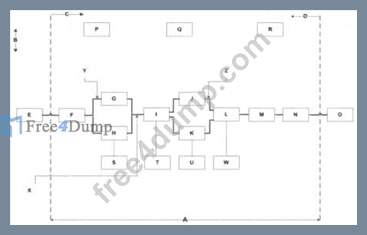
- A. Critical Logic Path
- B. "OR" Gate
- C. "AND" Gate
- D. Minor Logic Path
Answer: A
Explanation:
The diagram provided is a Function Analysis System Technique (FAST) diagram, a key tool in Value Methodology's Function Analysis phase, as taught in the VMF 1 course. FAST diagrams map the relationships between functions of a system, showing "how" and "why" relationships to identify the critical logic path (the primary sequence of functions that achieve the system's basic function) and minor logic paths (supporting functions). In FAST diagramming, functions are represented by boxes (e.g., G, H, J, K), and their relationships are shown with arrows.
* Yis a red arrow connecting function G to function J, running horizontally across the diagram. In FAST diagrams, the horizontal path from left to right represents thecritical logic path, which answers the question "how" each function is achieved to fulfill the system's primary purpose. Here, the path from E to F to G to J to L to M to N to O is the main sequence of functions, indicating the critical logic path.
* Z(another red arrow) points to a vertical connection between J and K, which represents a minor logic path-supporting functions that occur simultaneously or are secondary to the main path.
* Option A ("AND" Gate) and Option D ("OR" Gate) are incorrect because FAST diagrams use logic gates to show relationships between functions (e.g., AND for concurrent functions, OR for alternatives), but Y is an arrow on the main path, not a gate. Gates are typically symbols (e.g., triangles or diamonds) at junctions, not arrows.
* Option B (Minor Logic Path) is incorrect because minor logic paths are vertical connections in FAST diagrams (e.g., Z pointing to J-K), not the horizontal path that Y indicates.
* Option C (Critical Logic Path) is correct because Y lies on the main horizontal path, which represents the critical sequence of functions in a FAST diagram.
:
SAVE International, VMF 1 Core Competency #2 (Function Analysis), which includes the use of FAST diagrams to map critical and minor logic paths.
SAVE International, "Value Methodology Standard," section on Function Analysis, describing FAST diagramming conventions (horizontal for critical path, vertical for minor paths).
NEW QUESTION # 29
Which function represents the specific goals or needs for which the subject scope exists?
- A. Lower Order
- B. Basic
- C. Secondary
- D. Higher Order
Answer: D
Explanation:
In Value Methodology's Function Analysis, functions are classified based on their role in the system, as taught in the VMF 1 course (Core Competency #2). According to SAVE International's Value Methodology Standard, thehigher-order function"represents the specific goals or needs for which the subject scope exists-it answers 'why' the system or project is needed." In a FAST diagram, the higher-order function is located to the left of the basic function, just inside the left scope line, as seen in Question 18 (Function E). It defines the overarching objective or customer need that justifies the existence of the system (e.g., for a car, the higher-order function might be "provide mobility," while the basic function is "transport passengers").
* Option A (Basic) is incorrect because the basic function is the primary purpose of the system within the scope (e.g., "transport passengers"), not the overarching goal.
* Option B (Lower Order) is incorrect because "lower-order" is not a standard term in VM; it may refer to functions to the right of the basic function, which are more specific, not goal-oriented.
* Option C (Higher Order) is correct, as it represents the specific goals or needs for which the subject scope exists, per VM standards.
* Option D (Secondary) is incorrect because secondary functions support the basic function and do not represent the overarching goals.
:
SAVE International, VMF 1 Core Competency #2 (Function Analysis), defining higher-order functions as the goals or needs of the system.
SAVE International, "Value Methodology Standard," section on Function Analysis, describing the role of higher-order functions in FAST diagrams.
NEW QUESTION # 30
Which of the following best defines an activity?
- A. A specific task, action, or operation with a high level of abstraction
- B. A task, action, or operation that describes how a function is performed
- C. A task, action, or operation that describes why a function is performed
- D. A specific task, action, or operation that is generic and changes viewpoints
Answer: B
Explanation:
In Value Methodology's Function Analysis, the concepts of functions and activities are distinct but related, as taught in the VMF 1 course (Core Competency #2: Function Analysis). According to SAVE International's Value Methodology Standard, "a function is defined as what a product, process, or system does, expressed in a verb-noun format (e.g., 'contain liquid'), while an activity is a task, action, or operation that describes how a function is performed." For example, the function of a teacup might be "contain liquid," and the activity to achieve that function could be "holding the liquid in a ceramic structure." Activities are the actionable steps or processes that enable the function, often identified during the creation of a FAST diagram or Random Function Identification table (as noted in Question 19). The "how" aspect aligns with the How-Why logic of FAST diagrams, where activities detail the practical execution of a function.
* Option A (A task, action, or operation that describes why a function is performed) is incorrect because
"why" relates to the higher-order function or purpose (e.g., Question 20), not the activity, which focuses on "how."
* Option B (A specific task, action, or operation that is generic and changes viewpoints) is incorrect because activities are not about changing viewpoints; they are specific actions to perform a function.
* Option C (A task, action, or operation that describes how a function is performed) is correct, as it aligns with the definition of an activity in VM.
* Option D (A specific task, action, or operation with a high level of abstraction) is incorrect because activities are practical and specific, not abstract; functions are more abstract (e.g., verb-noun format).
:
SAVE International, VMF 1 Core Competency #2 (Function Analysis), distinguishing between functions (what) and activities (how).
SAVE International, "Value Methodology Standard," section on Function Analysis, defining activities as the tasks or operations that describe how functions are performed.
NEW QUESTION # 31
The best study results will usually come from applying the value methodology with:
- A. A team working in similar disciplines
- B. A multidisciplinary team with a selected set of skills
- C. An executive-level task force
- D. The current project team
Answer: B
Explanation:
Value Methodology (VM) relies heavily on effective team dynamics to achieve optimal results, as emphasized in the VMF 1 course (Core Competency #5: Value Team Dynamics). According to SAVE International's Value Methodology Standard, "the best VM study results are typically achieved with a multidisciplinary team with a selected set of skills, bringing diverse perspectives and expertise to analyze functions, generate ideas, and develop solutions." A multidisciplinary team includes members from different disciplines (e.g., engineering, finance, design, operations) relevant to the project, ensuring a comprehensive understanding of the system and fostering innovative solutions through varied viewpoints. The VMF 1 course highlights that such teams are more effective at identifying value improvement opportunities because they combine technical, financial, and operational insights.
* Option A (An executive-level task force) is incorrect because executives may lack the technical expertise needed for detailed function analysis and idea generation, though they may sponsor the study.
* Option B (A team working in similar disciplines) is incorrect because a lack of diversity in perspectives can limit creativity and overlook key opportunities, which a multidisciplinary team avoids.
* Option C (The current project team) is incorrect because the project team may be too close to the problem, potentially leading to bias and a narrower focus, whereas a multidisciplinary team brings fresh perspectives.
* Option D (A multidisciplinary team with a selected set of skills) is correct, as it aligns with VM best practices for achieving the best study results.
:
SAVE International, "Value Methodology Standard and Body of Knowledge," available athttps://www.value- eng.org, emphasizing the importance of multidisciplinary teams in VM studies.
SAVE International, VMF 1 Core Competency #5 (Value Team Dynamics), highlighting the effectiveness of diverse, skilled teams in VM.
NEW QUESTION # 32
......
Get to the Top with VMA Practice Exam Questions: https://passleader.free4dump.com/VMA-real-dump.html